Modes of Reproduction in Crop Plants
Modes of Reproduction in Crop Plants:-
फ़सली पौधों में दो प्रकार का जनन पाया जाता है:-
(Two types of reproduction are found in crop plants:-)
1. अलैंगिक जनन (Asexual reproduction)
2. लैंगिक जनन (Sexual reproduction)
1. अलैंगिक जनन (Asexual reproduction):- जब संतति पौधे का निर्माण नर व मादा युग्मक के संलयन के बिना होता है तो इसे अलैंगिक जनन कहते हैं। यह 2 प्रकार का होता है-
(When the progeny plant is developed without fusion of male and female gametes, it is called asexual reproduction. It is of two types-)
a. कायिक जनन (Vegetative reproduction)
b. असंग जनन (Apomixis)
a. कायिक जनन (Vegetative reproduction):- जब जनक पौधे के किसी कायिक भाग से संतति पौधे का विकास होता है तो इसे कायिक जनन कहते हैं। यह कई प्रकार का होता है-
(When the progeny plant develops from any somatic part of the parent plant, it is called vegetative reproduction. It includes-)
i. प्रकन्द (Rhizome):- अदरक, हल्दी
(Ginger, Turmeric)
ii. कन्द (Tuber):- आलू (Potato)
iii. बल्ब (Bulb):- प्याज, लहसुन
(Onion, Garlic)
iv. घनकन्द (Corm):- अरबी (Arbi)
b. असंग जनन (Apomixis):- जब जनक पौधे से भ्रूण व बीज का निर्माण बिना निषेचन के होता है तो इसे असंग जनन कहते हैं। बीजांड की कोई भी कायिक कोशिका ज़ाइगोट के समान कार्य करने लगती है। इसके फलस्वरूप बने संतति पौधे अपने जनकों के क्लोन होते हैं।
(When embryo and seed are produced from the parent plant without fertilization, it is called asexual reproduction. Any vegetative cell of the ovule acts as a zygote. The resulting seedlings are clones of their parents.)
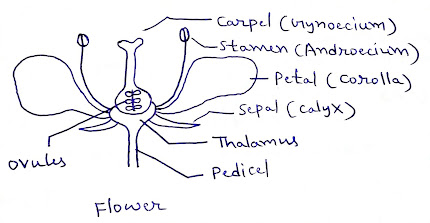
2. लैंगिक जनन (Sexual reproduction, Amphimixis):- जब जनक पौधों के नर व मादा युग्मकों के संलयन से भ्रूण व बीज का निर्माण होता है तो इसे लैंगिक जनन कहते हैं। फ़सली पौधों में लैंगिक जनन के लिए पुष्प होता है। जिसकी संरचना नीचे diagram में दी गयी है। पुष्प में नर जननांग को पुंकेसर व मादा जननांग को अंडप कहते हैं।
(When embryo and seed are developed by the fusion of male and female gametes of parent plants, it is called sexual reproduction. The crop plants have flowers for sexual reproduction. The structure of which is given in the diagram below. The male reproductive organs in the flower are called stamens and the female reproductive organs are called carpels.)


a. लघुबीजाणुजनन (Microsporogenesis)
b. गुरुबीजाणुजनन (Megasporogenesis)
c. परागण (Pollination)
d. निषेचन (Fertilization)
e. भ्रूण, बीज व फल का निर्माण (Embryo, Seed and Fruit formation)
a. लघुबीजाणुजनन (Microsporogenesis):- पुंकेसर में 2 भाग पुतन्तु व परागकोष होते हैं। पुंकेसर के परागकोषो में परागकणों का निर्माण होता है। प्रत्येक परागकोष में चारों कोनों पर चार कोष्ठक होते हैं जिन्हें लघुबीजाणुधानियाँ कहते हैं। प्रत्येक लघुबीजाणुधानी के अंदर द्विगुणित पराग मातृ कोशिका होती है। प्रत्येक पराग मातृ कोशिका में एक अर्धसूत्री विभाजन होने से लघुबीजाणु चतुष्क बनता है जिसमें 4 लघुबीजाणु होते हैं। प्रत्येक लघुबीजाणु के केंद्रक में एक समसूत्री विभाजन होने से दो केंद्रक बन जाते हैं। इस प्रकार प्रत्येक परागकण में 2 नर केंद्रक होते हैं। जैसा कि नीचे diagram में प्रदर्शित किया गया है।
(The stamen has 2 parts filament and anther. Pollens are formed in the anthers of stamens. Each anther has four chambers at its four corners called microsporangia. Each microsporangium contain many diploid pollen mother cells. Each pollen mother cell undergo a meiosis division which results in the fromation of a microspore tetrad consisting of 4 microspores. There is a mitotic division in the nucleus of each microspore, forming two nuclei. Thus each pollen has 2 male nuclei. As shown in the diagram below.)


b. गुरुबीजाणुजनन (Megasporogenesis):- अंडप में 3 भाग वर्तिकाग्र, वर्तिका व अंडाशय होते हैं। अंडप के अंडाशय में बीजांड लगे रहते हैं। बीजाण्ड को ही गुरुबीजाणुधानी कहा जाता है। बीजाण्डकाय की बीजाण्डद्वार के पास स्थित कोई एक कोशिका गुरुबीजाणु मातृ कोशिका में परिवर्तित हो जाती है। इस गुरुबीजाणु मातृ कोशिका में एक अर्धसूत्री विभाजन होने से रेखीय गुरुबीजाणु चतुष्क बनाता है जिसमें 4 गुरुबीजाणु होते हैं। ऊपर के तीन गुरुबीजाणु नष्ट हो जाते हैं व नीचे का केवल एक गुरुबीजाणु जीवित व सक्रिय रहता है। इस जीवित व सक्रिय गुरुबीजाणु के केंद्रक में 3 क्रमिक समसूत्री विभाजन होने से 8 केन्द्रकीय कोशिका बनती है जिसमें रूपान्तरण होने से 8 केन्द्रकीय व 7 कोशिकीय भ्रूणकोष बनाता है। इस प्रकार प्रत्येक बीजांड में एक भ्रूणकोष होता है जिसके अंदर 2 ध्रुवीय केंद्रक व एक अण्ड कोशिका मुख्य भाग होते हैं जो आगे चलकर निषेचन में भाग लेते हैं। जैसा कि नीचे diagram में प्रदर्शित किया गया है।
(The carpel consists of 3 parts stigma, style and ovary. Ovules are present in the ovaries of the carpels. The ovule is called megasporangium. A single cell located near the micropyle of the ovule is modified into a megaspore mother cell. This megaspore mother cell undergoes meiosis and creates a linear megaspore tetrad, which consists of 4 megaspores. The top three megaspores are destroyed and only one megaspore below remains alive and active. The nucleus of this living and active megaspore undergoes 3 successive mitotic divisions and forms 8 nucleated cell, which get modified and develop into 8 nucleated and 7 celled embryo sac. Thus each ovule contains an embryo sac inside which there are 2 polar nuclei and an egg cell are most important, which subsequently participate in fertilization. As shown in the diagram below.)


c. परागण (Pollination):- परागकणों का पुंकेसर के परागकोषों से निकलकर अंडप के वर्तिकाग्र तक पहुँचने की प्रक्रिया को परागण कहते हैं। जैसा कि नीचे diagram में प्रदर्शित किया गया है।
(The process of transfer of pollens from the anther of stamens to the stigma of the carpel, is called pollination. As shown in the diagram below.)


d. निषेचन (Fertilization):- अंडप की वर्तिकाग्र पर परागकण का अंकुरण होता है। परागनाल वर्तिकाग्र को भेदकर वर्तिका से होती हुई अंडाशय में बीजांड के अन्दर भ्रूणकोष तक पहुँच जाती है। दोनों नर केंद्रक भ्रूणकोष में छोड़ दिये जाते है। जैसा कि नीचे diagram में प्रदर्शित किया गया है।
(Pollen germinates on to the stigma of the carpel. Pollen tube penetrates the stigma, passing through the style and reaches the embryo sac inside the ovule in the ovary. Both male nuclei are released into the embryo sac. As shown in the diagram below.)


i. द्विनिषेचन (Double Fertilization):- एक नर केंद्रक अण्ड कोशिका से संलयन करके द्विगुणित जाइगोट बनाता है तथा दूसरा नर केंद्रक 2 ध्रुवीय केंद्रकों से संलयन करके त्रिगुणित PEN बनाता है।
[One male nucleus fused to the egg cell to form a diploid zygote and the other male nucleus fused to 2 polar nuclei to form a tiploid PEN (Primary Endosperm Nucleus). As shown in the diagram below.]


ii. त्रिकसंलयन (Triple Fusion):- एक नर केंद्रक व 2 ध्रुवीय केंद्रक संलयन करके त्रिगुणित प्राथमिक भ्रूणपोष केंद्रक (PEN) बनाते हैं। इस प्रकार यहाँ तीन केंद्रक संलयन करते हैं। जैसा कि नीचे diagram में प्रदर्शित किया गया है।
(A male nucleus and 2 polar nuclei are fused together to form a triploid primary endosperm nucleus (PEN). Thus here three nuclei are fused. As shown in the diagram below.)

e. भ्रूण, बीज व फल का निर्माण (Embryo, Seed and Fruit formation):- द्विगुणित ज़ाइगोट भ्रूण में परिवर्धित हो जाता है। त्रिगुणित PEN भ्रूणपोष में परिवर्धित हो जाता है जो भ्रूण को पोषण प्रदान करने का कार्य करता है। सम्पूर्ण बीजांड बीज में परिवर्तित हो जाता है। सम्पूर्ण अंडाशय फल में परिवर्तित हो जाता है। जैसा कि नीचे diagram में प्रदर्शित किया गया है।
(The diploid zygote develops into the embryo. The triploid PEN is developed into endosperm which provide nourishment to the developing embryo. The entire ovule is turns into a seed. The entire ovary turns into a fruit. As shown in the diagram below.)


(Pollination is the process of the transfer of pollen from the anther of the stamens on to the surface of the stigma. Pollination is of 2 types: -)
1. स्वपरागण
2. परपरागण
1. स्वपरागण (Self Pollination):- जब एक पुष्प के परागकण उसी पौधे के पुष्प की वर्तिकाग्र पर स्थानांतरित होते हैं तो इसे स्वपरागण कहते हैं। 2 प्रकार-
(When the pollen of a flower is transferred on to the stigma of the flower of the same plant, it is called self-pollination. 2 types-)
a. स्वयुग्मन(Autogamy)
b. विषमयुग्मन (Geitonogamy)
a. स्वयुग्मन (Autogamy):- जब एक पुष्प के परागकण उसी पुष्प की वर्तिकाग्र पर स्थानांतरित होते हैं तो इसे स्वयुग्मन कहते हैं।
(When the pollen of a flower is transferred on to the stigma of the same flower, it is called autogamy.)


b. विषमयुग्मन (Geitonogamy):- जब एक पुष्प के परागकण उसी पौधे के दूसरे पुष्प की वर्तिकाग्र पर स्थानांतरित होते हैं तो इसे विषमयुग्मन कहते हैं।
(When the pollen of one flower is transferred on to the stigma of another flower of the same plant, it is called Geitonogamy.)


स्वपरागण के लिए पौधों में अनुकूलताएं:-
(Adaptations in plants for self-pollination: -)
I. द्विलिंगता (Bisexuality):- जब पौधों में द्विलिंगी पुष्प पाये जाते हैं तो इसे द्विलिंगता कहते हैं। द्विलिंगी पुष्पों में नर भाग पुंकेसर व मादा भाग अण्डप दोनों एक ही पुष्प में पाये जाते हैं। इस प्रकार परागकोष व वर्तिकाग्र दोनों पास पास स्थित होते हैं। परागकोष के स्फुटित होते ही परागकण पास स्थित वर्तिकाग्र पर आसानी से स्थानांतरित हो जाते हैं और स्वपरागण हो जाता है। इस प्रकार स्वपरागण के लिए पौधों में द्विलिंगी पुष्पों का होना आवश्यक है इसलिए स्वपरागित फसलों में हमेशा द्विलिंगी पुष्प ही पाये जाते हैं।
(When bisexual flowers are found in plants, it is called bisexuality. In bisexual flowers, both the male part stamens and the female part carpels are found in the same flower. Thus both anther and stigma are located close to each other. As soon as the anther is dehisced, the pollen gets transferred easily to the stigma near it and self-pollination occurs. Thus, it is necessary for plants to have bisexual flowers for self-pollinating, so bisexual flowers are always found in self-pollinated crops.)

II. समकालपक्वता (Homogamy):- जब द्विलिंगी पुष्प के परागकोष व वर्तिकाग्र दोनों एक ही समय परिपक्व होते हैं तो इसे समकालपक्वता कहते हैं। अर्थात जिस समय परिपक्व परागकोषों का स्फुटन होता है उस समय वर्तिकाग्र ग्राही अवस्था में होती है। इस प्रकार स्वपरागण के लिए पौधों में समकालपक्वता का होना आवश्यक है इसलिए स्वपरागित फसलों में समकालपक्वता पायी जाती है।
(When both the anther and the stigma of a bisexual flower mature at the same time, it is called homogamy. That is, the stigma is in the receptive state at the time when the mature anther is dehisced. Thus, it is necessary to have homogamy in plants for self-pollination, therefore, homogamy is found in self-pollinated crops.)


III. निमिलित परागण (Cleistogamy):- जब परागण व निषेचन एक बंद पुष्प कलिका में होता है तो इसे निमिलित परागण कहते हैं। यह स्वपरागण को सुनिश्चित करता है और परपरागण को रोकता है। कुछ फसलों में ही यह पाया जाता है जैसे - गेहूँ, जौं, जई व अन्य घास जातियाँ।
(When pollination and fertilization occurs in a closed flower bud, it is called Cleistogamy. This ensures self-pollination and prevents cross-pollination. It is found only in some crops such as wheat, barley, oats and other grass species.)
IV. उन्मील परागण (Chasmogamy):- जब पुष्प परागण की प्रक्रिया पूर्ण होने के पश्चात खुलता है तो इसे उन्मील परागण कहते हैं। यह स्वपरागण को सुनिश्चित करता है और परपरागण को रोकता है।कुछ फसलों में ही यह पाया जाता है जैसे - गेहूँ, जौं, जई व धान।
(When the flower opens after the completion of pollination process, it is called chasmogamy. It ensures self-pollination and prevents cross-pollination. It is found only in some crops such as wheat, barley, oats and paddy.)
V. परागकोषों की स्थिति (Position of Anthers):- कुछ जातियों में वर्तिकाग्र चारों ओर से परागकोषों से इस प्रकार घिरी रहती है कि यह स्वपरागण को सुनिश्चित करती है। यह स्थिति टमाटर व बैंगन में पायी जाती है। लेग्यूम फसलों में पुंकेसर व वर्तिकाग्र दलों में इस प्रकार से बंद रहते हैं कि ये स्वपरागण को सुनिश्चित करते है। जैसे मटर, चना, सोयाबीन आदि।
(In some species, the stigma is surrounded by anthers around it in such a way that it ensures self-pollination. This condition is found in tomato and brinjal. In legume crops, stamens and stigmas remain enclosed in such a way that they ensure self-pollination. Such as peas, chickpeas, soybeans etc.)
स्वपरागित फसलों के उदाहरण (Examples of Self Pollinated Crops):- गेहूँ, जौं, धान, जई, मटर, मूंगफली, चना, सोयाबीन, टमाटर, भिंडी, बैंगन, मिर्च, आलू आदि।
(Wheat, Barley, Paddy, Oats, Peas, Groundnut, Gram, Soybean, Tomato, Okra, Brinjal, Chilli, Potato etc.)
2. परपरागण (Cross Pollination):- जब एक पुष्प के परागकण दूसरे पौधे के पुष्प की वर्तिकाग्र पर स्थानांतरित होते हैं तो इसे परपरागण कहते है।
(When the pollen of one flower is transferred on to the stigma of flower of another plant, it is called cross pollination.)


परागण कारक (Pollinating Agents):- जो परागकणों को एक पौधे से दूसरे पौधे पर लेकर जाते है।
(Which carry pollens from one plant to another.)
i. कीट परागण (Entomophilly):- कीटों के द्वारा परागकणों को एक पुष्प से दूसरे पुष्प पर स्थानांतरित किया जाता है। मधुमक्खियों का योगदान सर्वाधिक रहता है।
(Pollens are transferred from one flower to another flower by insects. Honey bees contribute the most.)
ii. वायु परागण (Anemophilly):-
(Pollens are transferred from one flower to another flower by air. Examples - Poaceae family plants)
iii. जल परागण (Hydrophilly):- जल के द्वारा परागकणों को एक पुष्प से दूसरे पुष्प पर स्थानांतरित किया जाता है। उदाहरण - जलीय पौधे
(Pollens are transferred from one flower to another flower by water. Examples - aquatic plants)
iv. जन्तु परागण (Zoophilly):- जंतुओं के द्वारा परागकणों को एक पुष्प से दूसरे पुष्प पर स्थानांतरित किया जाता है।
(Pollens are transferred from one flower to another flower by animals.)
परपरागण के लिए पौधों में अनुकूलताएं:-
(Adaptations in plants for cross-pollination: -)
I. एकलिंगता (Dicliny, Unisexuality):- जब पौधों में एकलिंगी पुष्प पाये जाते हैं तो इसे एकलिंगता कहते हैं। एकलिंगी पुष्पों में केवल नर भाग पुंकेसर या मादा भाग अण्डप एक ही उपस्थित होता है। इस प्रकार परागकोष व वर्तिकाग्र दोनों दूर दूर स्थित होते हैं।
(When unisexual flowers are found in plants, it is called unisexuality. In unisexual flowers, only the male part stamens or the female part carpels are present. Thus both anther and stigma are located far away.)


नर व मादा पुष्पों की स्थिति के आधार पर यह दो प्रकार की होती है:-
(Depending on the position of male and female flowers, it is of two types: -)
i. द्विलिंगाश्रीयता (Monoecy)
ii. एकलिंगाश्रीयता (Dioecy)
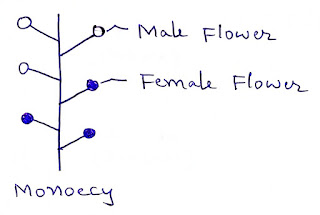
i. द्विलिंगाश्रीयता (Monoecy):- जब नर व मादा पुष्प दोनों एक ही पौधे पर उपस्थित होते हैं तो इसे द्विलिंगाश्रीयता कहते हैं। उदाहरण - आम, अरंडी, केला, मक्का, कुकुरबिट्स, अंगूर, स्ट्रौबरी, रबर, कसावा आदि। आम, अरंडी, केला में नर व मादा पुष्प एक ही पुष्पक्रम में पाये जाते हैं। मक्का में नर व मादा पुष्प अलग अलग पुष्पक्रमों में पाये जाते हैं।
(When both male and female flowers are present on the same plant, it is called monoecy. Examples - Mango, castor, banana, corn, cucurbits, grapes, strawberry, rubber, cassava etc. In mango, castor and banana, male and female flowers are found in the same inflorescence. Male and female flowers are found in different inflorescences in maize.)

ii. एकलिंगाश्रीयता (Dioecy):- जब नर व मादा पुष्प अलग अलग पौधों पर उपस्थित होते हैं तो इसे एकलिंगाश्रीयता कहते हैं। उदाहरण - पपीता, खजूर, शहतूत, पालक, सन, शतावर आदि।
(When male and female flowers are present on different plants, it is called dioecy. Examples - papaya, date Palm, mulberry, spinach, sunn, shatavar etc.)


II. विषमकालपक्वता (Dichogamy):- जब द्विलिंगी पुष्प के परागकोष व वर्तिकाग्र दोनों अलग अलग समय पर परिपक्व होते हैं तो इसे विषमकालपक्वता कहते हैं। अर्थात जिस समय परिपक्व परागकोषों का स्फुटन होता है उस समय वर्तिकाग्र ग्राही अवस्था में नहीं होती है। यह परपरागण को प्रोत्साहित करती है। यह दो प्रकार की होती है:-
(When both the anther and the stigma of a bisexual flower mature at different times, it is called dichogamy. It means, the stigma is not in the receptive state when the mature pollen is dehisced. It encourages cross-pollination. It is of two types:-)
i. स्त्रीपूर्वता (Protogyny)
ii. पुंपूर्वता (Protandry)
i. स्त्रीपूर्वता (Protogyny):- जब वर्तिकाग्र परागकोषों से पहले परिपक्व हो जाती है तो इसे स्त्रीपूर्वता कहते हैं। उदाहरण - बाजरा
(When the stigma matures before the anther, it is called protogyny. Example - Bajra)


ii. पुंपूर्वता (Protandry):- जब परागकोष वर्तिकाग्र से पहले परिपक्व हो जाते हैं तो इसे पुंपूर्वता कहते हैं। उदाहरण - मक्का, चुकंदर व अनेक अन्य जातियाँ।
(When anthers mature before stigma, it is called protandry. Examples - Maize, sugar beet and many other species.)


III. विषमवर्तिकी (Heterostyly):- जब एक पुष्प में पुतन्तु व वर्तिका भिन्न भिन्न लंबाई के होते हैं तो इसे विषमवर्तिकी कहते हैं। यह परपरागण को प्रोत्साहित करती है। उदाहरण - अलसी
(When the filament and style in a flower are of different lengths, it is called heterostyly. It encourages cross-pollination. Example - Linseed)


IV. हर्कोगेमी (Herkogamy):- जब द्विलिंगी पुष्प में परागकोष व वर्तिकाग्र के मध्य कोई भौतिक बाधा उपस्थित होती है तो इसे हर्कोगेमी कहते हैं। इस भौतिक बाधा के कारण स्वपरागण में बाधा पड़ती है। इस प्रकार यह परपरागण को प्रोत्साहित करती है। उदाहरण - एल्फाएल्फा (लूसर्न)। इस पौधे में वर्तिकाग्र के ऊपर एक हायलिन झिल्ली पायी जाती है जो स्वपरागण को रोकती है। यह झिल्ली मधुमक्खियों के पुष्पों पर बैठने से टूटती है। इसके साथ ही मधुमक्खियों के शरीर पर लगे परागकणों द्वारा इन पुष्पों में परपरागण भी हो जाता है।
(When there is a physical barrier between the anther and the stigma in a bisexual flower, it is called herkogamy. Due to this physical barrier, self pollination is not possible. Thus, it encourages cross-pollination. Example - Alpha alpha (Lucerne). In this plant, a hyaline membrane is found above the stigma, which prevents self-pollination. This membrane breaks when the bees sit on the flowers. As a result, cross pollination takes place by the pollens which are attached on the body of the bees.)


V. स्वअनिषेच्यता (Self Incompatibility):- जब एक उर्वर परागकण उसी पुष्प को निषेचित करने में असमर्थ होता है तो इसे स्वअनिषेच्यता कहते हैं। यह स्वपरागण को रोकता है और परपरागण को प्रोत्साहित करता है। उदाहरण - सरसों, मूली, तंबाकू और अनेक घास जातियाँ।
(When a fertile pollen is unable to fertilize the same flower, it is called self incompatibility. It inhibits self-pollination and encourages cross-pollination. Examples - mustard, radish, tobacco and many grass species.)
VI. नर बंध्यता (Male Sterility):- जब एक पौधे के परागकण अजीवित व निष्क्रिय होते हैं अर्थात निषेचन करने में असमर्थ होते हैं तो इसे तो इसे नर बंध्यता कहते हैं। यह स्वपरागण को रोकता है और परपरागण को प्रोत्साहित करता है। संकर बीज उत्पादन के लिए यह एक महत्वपूर्ण साधन है।
(When the pollens of a plant are dead and inactive, it means unable to fertilize, it is called male sterility. It inhibits self-pollination and encourages cross-pollination. It is an important tool for hybrid seed production.)
परपरागित फसलों के उदाहरण (Examples of Cross Pollinated Crops):- मक्का, बाजरा, सूरजमुखी, अरंडी, लूसर्न, गन्ना, गाजर, गोभी, प्याज, मूली, शलजम, पालक, धनियाँ आदि।
(Maize, bajra, sunflower, castor, lucerne, sugarcane, carrot, cabbage, onion, radish, turnip, spinach, coriander etc.)
असंग जनन (Apomixis):- जब जनक पौधे से भ्रूण व बीज का निर्माण बिना निषेचन के होता है तो इसे असंग जनन कहते हैं। बीजांड की कोई भी कायिक कोशिका ज़ाइगोट के समान कार्य करने लगती है। इसके फलस्वरूप बने संतति पौधे अपने जनकों के क्लोन होते हैं। यह तीन प्रकार का होता है -
(When embryo and seed are produced from the parent plant without fertilization, it is called asexual reproduction. Any vegetative cell of the ovule acts as a zygote. The resulting seedlings are clones of their parents. It is of three types -)
I. अपस्थानिक भ्रूणता (Adventive Embryony)
II. अपबीजाणुकता (Apospory)
III. द्विबीजाणुकता (Diplospory)
I. अपस्थानिक भ्रूणता (Adventive Embryony):- जब भ्रूण का विकास बीजाण्ड की किसी कायिक कोशिका (अध्यावरण या बीजाण्डकाय या निभाग) से बिना भ्रूणकोष बने होता है तो इसे अपस्थानिक भ्रूणता कहते हैं। जैसा कि नीचे diagram में प्रदर्शित किया गया है। उदाहरण:- नींबू, आम आदि।
(When the embryo develops from a vegetative cell of ovule (integument or nucellus or challaza) without the formation of embryo sac, it is called adventive embryony. As shown in the diagram below. Examples: Lemon, mango etc.)


.bmp)
II. अपबीजाणुकता (Apospory):- जब भ्रूणकोष का विकास बीजाण्ड की किसी कायिक कोशिका (अध्यावरण या बीजाण्डकाय या निभाग) से बिना अर्धसूत्री विभाजन हुए होता है तो इसे अपबीजाणुकता कहते हैं। अर्थात यहाँ गुरुबीजाणु का निर्माण नहीं होता है। भ्रूणकोष की प्रत्येक कोशिका द्विगुणित होती है। भ्रूणकोष की किसी भी एक कोशिका से भ्रूण बन जाता है। जैसा कि नीचे diagram में प्रदर्शित किया गया है। उदाहरण:- Crepis
(When the development of the embryo sac occurs without meiosis from any vegetative cell of ovule (integument or nucellus or challaza), it is called as apospory. It means megaspore is not produced here. Each cell of the embryo sac is diploid. An embryo is developed from any one cell of the embryo sac. As shown in the diagram below. Example: - Crepis)


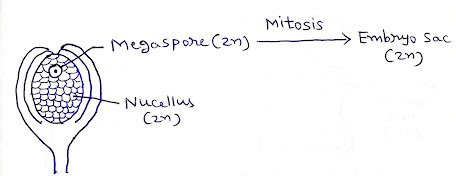
III. द्विबीजाणुकता (Diplospory):- जब भ्रूणकोष का विकास द्विगुणित गुरुबीजाणु से होता है तो इसे द्विबीजाणुकता कहते हैं। गुरुबीजाणु का निर्माण बिना अर्धसूत्री विभाजन के होने के कारण यह द्विगुणित होता है। अत: भ्रूणकोष की प्रत्येक कोशिका भी द्विगुणित होती है। जैसा कि नीचे diagram में प्रदर्शित किया गया है।
(When the embryo sac develops from a diploid megaspore, it is called as diplospory. Megaspore is diploid because it is formed by mitosis instead of meiosis. Therefore, each cell in the embryo sac is also diploid. As shown in the diagram below.)

भ्रूण का विकास निषेचन के बिना होता है। भ्रूण का विकास भ्रूणकोष की कौनसी कोशिका से होता है, इस आधार पर द्विबीजाणुकता 2 प्रकार की होती है-
(Embryo development occurs without fertilization. Depending upon the embryo develops from which cell of the embryo sac, there are 2 types of diplospory -)
i. अनिषेकजनन (Parthenogenesis)
ii. अपयुग्मन (Apogamy)
i. अनिषेकजनन (Parthenogenesis):- जब भ्रूण का विकास अण्ड कोशिका से होता है तो इसे अनिषेकजनन कहते है। जैसा कि नीचे diagram में प्रदर्शित किया गया है। उदाहरण:- Taraxacum (घास)
[When the embryo develops from the egg cell, it is called parthenogenesis. As shown in the diagram below. Example: - Taraxacum (grass)]


ii. अपयुग्मन (Apogamy):- जब भ्रूण का विकास प्रतिमुखी कोशिका या सहायक कोशिका से होता है तो इसे अपयुग्मन कहते हैं। जैसा कि नीचे diagram में प्रदर्शित किया गया है। उदाहरण:- प्याज
(When the embryo develops from the antipodal cell or the synergid, it is called apogamy. As shown in the diagram below. Example: - Onion)


.bmp)