2020 - 21 Solved Old Paper (AGRON - 211)


.png)
SRI (System of Rice Intensification) (चावल सघनता प्रणाली):- It is a crop production approach for rice that enhances productivity by improving plant establishment, soil health, water use efficiency, and nutrient management, without increasing external inputs.
(यह चावल की फसल उत्पादन की एक ऐसी विधि है जो बाहरी संसाधनों को बढ़ाए बिना पौधों की स्थापना, मिट्टी की सेहत, जल उपयोग दक्षता और पोषक तत्व प्रबंधन में सुधार करके उत्पादकता बढ़ाती है।)
Main Principles of SRI (SIR के मुख्य सिद्धांत):-
i. Young seedlings (युवा पौधे):- Transplant 8–14 days old seedlings.
(8-14 दिन पुराने पौधों को रोपें।)
ii. Single seedling per hill (प्रति टीला एक पौधा):- Avoid clump planting.
(गुच्छों में रोपण से बचें।)
iii. Wider spacing (अधिक दूरी):- Square planting (about 25 × 25 cm).
[वर्गाकार रोपण (लगभग 25 × 25 सेमी)।]
iv. Water management (जल प्रबंधन):- Keep soil moist using alternate wetting and drying, not continuous flooding.
(मिट्टी को लगातार जलभराव से बचाकर, बारी-बारी से गीला और सूखा करके नम रखें।)
v. Mechanical weeding (यांत्रिक निराई):- Use cono/rotary weeders to control weeds and aerate soil.
(खरपतवारों को नियंत्रित करने और मिट्टी को हवादार बनाने के लिए कोनो/रोटरी वीडर का उपयोग करें।)
vi. Organic nutrition (जैविक पोषण):- Greater use of FYM, compost, green manure and biofertilizers.
(गोबर की खाद, कम्पोस्ट, हरी खाद और जैव उर्वरकों का अधिक उपयोग करें।)
.png)
Ginning:- It is the process of separating cotton fibres (lint) from cotton seeds after harvesting. It is a crucial post-harvest operation that determines lint quality, market value, and spinning performance.
Ginning Outturn (GOT):-

Normal GOT:- 30–40%

Aflatoxins (एफ्लाटॉक्सिन):- These are toxic secondary metabolites produced mainly by the fungi Aspergillus flavus and Aspergillus parasiticus. Groundnut is one of the most susceptible crops to aflatoxin contamination.
(ये विषैले द्वितीयक मेटाबोलाइट्स हैं जो मुख्य रूप से एस्परजिलस फ्लेवस और एस्परजिलस पैरासिटिकस नामक कवकों द्वारा उत्पन्न होते हैं। मूंगफली एफ्लाटॉक्सिन संदूषण के प्रति सबसे अधिक संवेदनशील फसलों में से एक है।)
Types (प्रकार):-
i. Aflatoxin B₁ – most toxic and carcinogenic (most important)
[एफ्लाटॉक्सिन B₁ – सबसे विषैला और कैंसरकारक (सबसे महत्वपूर्ण)]
ii. Aflatoxin B₂, G₁, G₂
(एफ्लाटॉक्सिन B₂, G₁, G₂)
.png)
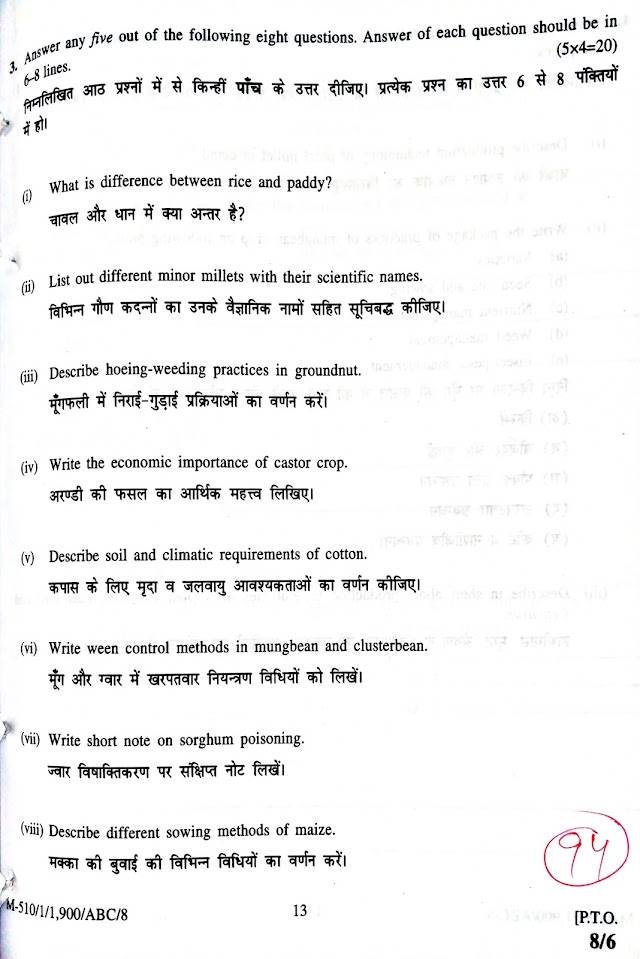
Millets (मिलेट्स):- These are a group of small-seeded cereal crops belonging to the family Poaceae. They are hardy crops, grown mainly in arid and semi-arid regions, and are known for their drought tolerance, low input requirement, and high nutritional value.
(ये पोएसी कुल से संबंधित छोटे बीजों वाली अनाज फसलों का एक समूह है। ये कठोर फसलें हैं, जो मुख्य रूप से शुष्क और अर्ध-शुष्क क्षेत्रों में उगाई जाती हैं, और अपनी सूखा सहनशीलता, कम लागत और उच्च पोषण मूल्य के लिए जानी जाती हैं।)
Classification of Millets (मिलेट्स का वर्गीकरण):-
a. Major Millets (प्रमुख मिलेट्स):-
i. Sorghum (Jowar) (ज्वार)
ii. Pearl millet (Bajra) (बाजरा)
iii. Finger millet (Ragi) (रागी)
b. Minor / Small Millets (लघु मिलेट्स):-
i. Foxtail millet (Kangni) (कांगनी)
ii. Little millet (Kutki) (कुटकी)
iii. Kodo millet (कोदो मिलेट)
iv. Proso millet (Cheena) (चीना)
v. Barnyard millet (Sanwa) (सनवा)
.png)
Baby Corn (बेबी कॉर्न):- Young maize harvested before pollination. Varieties include VL-78 and VL-79.
(युवा मक्का जिसे परागण से पहले काटा जाता है। किस्में: VL-78, VL-79)
.png)
Camel crop (कैमल क्रॉप):- It refers to Camelina (Camelina sativa), an oilseed crop belonging to the family Brassicaceae. It is also known as false flax or gold-of-pleasure.
[यह कैमेलिना (कैमेलिना सैटिवा) को संदर्भित करता है, जो ब्रैसिकेसी कुल से संबंधित एक तिलहन फसल है। इसे फाल्स फ्लैक्स या गोल्ड-ऑफ-प्लेजर के नाम से भी जाना जाता है।]
Botanical Details (वनस्पतिक विवरण):-
Botanical name (वनस्पति नाम):- Camelina sativa (कैमेलिना सैटाइवा)
Family (कुल):- Brassicaceae (ब्रैसिकेसी)
Chromosome number (गुणसूत्र संख्या):- 2n = 40
Type (प्रकार):- Oilseed crop (तिलहन फसल)
.png)
Soy Protein (सोया प्रोटीन):- Soybean is a globally significant crop known for its high protein content and oil production. It plays a vital role in human food, animal feed, and industrial applications.
(सोयाबीन एक वैश्विक स्तर पर महत्वपूर्ण फसल है, जो अपने उच्च प्रोटीन सामग्री और तेल उत्पादन के लिए जानी जाती है। यह मानव भोजन, पशु चारा, और औद्योगिक उपयोगों में महत्वपूर्ण भूमिका निभाती है।)
> The protein percentage in soybean seeds typically ranges between 38–42%, with an average of around 40% on a dry-weight basis.
(सोयाबीन के बीजों में प्रोटीन का प्रतिशत आमतौर पर 38-42% के बीच होता है, तथा शुष्क भार के आधार पर औसतन लगभग 40% होता है।)
.png)
Forage crops (चारा फसलें):- These are crops grown primarily to provide green fodder, dry fodder, hay, or silage for livestock. They play a vital role in livestock nutrition, dairy production, and integrated farming systems.
(ये मुख्य रूप से पशुओं के लिए हरा चारा, सूखा चारा, सूखी घास या साइलेज उपलब्ध कराने के लिए उगाई जाने वाली फसलें हैं। ये पशुओं के पोषण, दुग्ध उत्पादन और एकीकृत कृषि प्रणालियों में महत्वपूर्ण भूमिका निभाती हैं।)
a. Leguminous Forage Crops (दलहनी चारा फसलें):-
i. Berseem (Trifolium alexandrinum)
[बरसीम (ट्राइफोलियम एलेक्जेंड्रिनम)]
ii. Lucerne / Alfalfa (Medicago sativa)
[ल्यूसर्न / अल्फाल्फा (मेडिकागो सैटिवा)]
iii. Cowpea
(लोबिया)
iv. Cluster bean (Guar)
(ग्वार)
Note (नोट):- Rich in protein and improve soil fertility through nitrogen fixation.
(प्रोटीन से भरपूर और नाइट्रोजन स्थिरीकरण द्वारा मिट्टी की उर्वरता में सुधार करती हैं।)
b. Non-leguminous Forage Crops (गैर दलहनी चारा फसलें):-
i. Sorghum (Jowar)
(ज्वार)
ii. Maize
(मक्का)
iii. Oats
(जई)
iv. Bajra
(बाजरा)
v. Napier grass
(नेपियर घास)
.png)
Kharif (खरीफ):- It refers to crops that are sown with the onset of the southwest monsoon and harvested at the end of the rainy season in India.
(भारत में दक्षिण-पश्चिम मानसून के प्रारंभ में बोई जाने वाली और वर्षा ऋतु के अंत में काटी जाने वाली फसलें खरीफ कहलाती हैं।)
Season (ऋतु):-
Sowing (बुवाई):- June–July
(जून-जुलाई)
Harvesting (कटाई):- September–October (some extend to November)
[सितंबर-अक्टूबर (कुछ फसलों की कटाई नवंबर तक भी चलती है)]
.png)
Lasiurus scindicus:- The Lasiurus genus, commonly known as the Lasiurus or Tropical Grass, is a genus of flowering plants in the family Poaceae (grasses). In India, the species under this genus are important for their ecological and agricultural roles.
[लासियूरस जाति, जिसे आमतौर पर लासियूरस या उष्णकटिबंधीय घास के नाम से जाना जाता है, पोएसी (घास) कुल की पुष्पों वाली पौधों की जाति है। भारत में, इस जाति के पौधे अपने पारिस्थितिकीय और कृषि संबंधी भूमिकाओं के लिए महत्वपूर्ण हैं।]
.png)
Thinning (विरलीकरण ):- It is an agronomic operation in which excess plants or seedlings are removed from a field to maintain optimum plant population and spacing for healthy crop growth.
(यह एक कृषि प्रक्रिया है जिसमें स्वस्थ फसल वृद्धि के लिए इष्टतम पौधों की संख्या और उचित दूरी बनाए रखने हेतु खेत से अतिरिक्त पौधों या अंकुरों को हटा दिया जाता है।)
Purpose of Thinning (विरलीकरण का उद्देश्य):-
> To reduce competition for light, water, nutrients, and space
(प्रकाश, पानी, पोषक तत्वों और स्थान के लिए प्रतिस्पर्धा कम करना)
> To ensure uniform plant stand
(पौधों की एकसमान संख्या सुनिश्चित करना)
> To promote better root and canopy development
(जड़ों और छत्र के बेहतर विकास को बढ़ावा देना)
> To increase yield and quality
(उपज और गुणवत्ता बढ़ाना)
.png)
Guar gum (ग्वार गम):- It is a natural polysaccharide obtained from the endosperm of guar seeds (Cyamopsis tetragonoloba). It is widely used as a thickening, stabilizing, and binding agent in food and industrial applications.
[यह ग्वार के बीजों (Cyamopsis tetragonoloba) के अंतःशुक्राणु से प्राप्त एक प्राकृतिक पॉलीसेकेराइड है। इसका व्यापक रूप से खाद्य और औद्योगिक अनुप्रयोगों में गाढ़ापन लाने, स्थिरता प्रदान करने और बंधनकारी पदार्थ के रूप में उपयोग किया जाता है।]
Source Crop (स्रोत फसल):- Guar / Cluster Bean
(ग्वार / क्लस्टर बीन)
Botanical name (वानस्पतिक नाम):- Cyamopsis tetragonoloba
Family (कुल):- Fabaceae
Major producing states (India) [प्रमुख उत्पादक राज्य (भारत)]:- Rajasthan, Gujarat, Haryana
(राजस्थान, गुजरात, हरियाणा)
Note (नोट):- Grown mainly as a kharif crop
(:- मुख्य रूप से खरीफ की फसल के रूप में उगाया जाता है)

Phyllody (फाइलोडी):- It is a plant disease/symptom in which floral organs are transformed into leaf-like structures, resulting in abnormal, sterile flowers.
(यह एक पादप रोग/लक्षण है जिसमें पुष्पीय अंग पत्ती जैसी संरचनाओं में परिवर्तित हो जाते हैं, जिसके परिणामस्वरूप असामान्य, बांझ फूल उत्पन्न होते हैं।)
Cause (कारण):-
> Caused by phytoplasma (mycoplasma-like organisms)
[फाइटोप्लाज्मा (माइकोप्लाज्मा जैसे जीव) के कारण होता है]
> Transmitted mainly by leafhopper insects (e.g., Orosius spp.)
[मुख्यतः लीफहॉपर कीटों (जैसे, ओरोसियस जाति.) द्वारा फैलता है]