Food Chain (खाध्य शृंखला):- Flow of energy in an ecosystem is one way process. The sequence of organism through which the energy flows, is known as food chain.
(किसी पारिस्थीतिक तंत्र में ऊर्जा का प्रवाह एक तरफ़ा प्रक्रिया है। जीवों का वह क्रम जिसके माध्यम से ऊर्जा प्रवाहित होती है, खाद्य श्रृंखला कहलाती है।)
> Food chains were first introduced by the Arab scientist and philosopher Al-Jahiz in the 10th century and later popularized in a book published in 1927 by Charles Elton, which also introduced the food web concept.
(खाद्य श्रृंखलाएं पहली बार 10वीं शताब्दी में अरब वैज्ञानिक और दार्शनिक अल-जाहिज़ द्वारा पेश की गईं और बाद में चार्ल्स एल्टन द्वारा 1927 में प्रकाशित एक पुस्तक में लोकप्रिय हुईं, जिसने खाद्य वेब अवधारणा भी पेश की।)
> Each food chain is made up of different trophic levels.
(प्रत्येक खाद्य श्रृंखला विभिन्न पोषक स्तरों से बनी होती है।)
> Each organism represents a trophic level.
(प्रत्येक जीव एक पोषक स्तर का प्रतिनिधित्व करता है।)
> Each organism obtains energy from the organism of its lower trophic level.
(प्रत्येक जीव अपने निचले पोषक स्तर के जीव से ऊर्जा प्राप्त करता है।)
> Plants are called producers because they create their own food through photosynthesis.
(पौधों को उत्पादक कहा जाता है क्योंकि वे प्रकाश संश्लेषण के माध्यम से अपना भोजन स्वयं बनाते हैं।)
> Animals are consumers because they cannot create their own food, they must eat plants or other animals to get the energy that they need.
(जन्तु उपभोक्ता होते हैं क्योंकि वे अपना भोजन स्वयं नहीं बना सकते, उन्हें आवश्यक ऊर्जा प्राप्त करने के लिए पौधों या अन्य जंतुओं को खाना पड़ता है।)
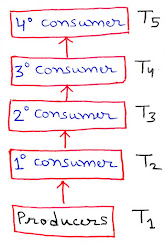
Trophic levels in a food chain (खाद्य श्रृंखला में पोषक स्तर):- Each food chain is made up of different trophic levels. Each organism represents a trophic level. They are represented as T1, T2, T3 etc.
(प्रत्येक खाद्य श्रृंखला विभिन्न पोषक स्तरों से बनी होती है। प्रत्येक जीव एक पोषक स्तर का प्रतिनिधित्व करता है। इन्हें T1, T2, T3 आदि के रूप में दर्शाया जाता है।)
a. Producers (उत्पादक) (T1)
b. Consumers (उपभोक्ता):-
i. Primary consumers (प्राथमिक उपभोक्ता) (T2)
ii. Secondary consumers (द्वितीयक उपभोक्ता) (T3)
iii. Tertiary consumers (तृतीयक उपभोक्ता) (T4)
iv. Quaternary consumers (चतुर्थक उपभोक्ता) (T5)
c. Decomposers (अपघटक)
Types of Food Chain (खाध्य श्रखला के प्रकार):-
a. Grazing Food Chain (चराई खाद्य श्रृंखला):-
- This type of food chain starts from the living green plants, goes to grazing herbivores (that feed on living plant materials with their predators), and on to carnivores (animal eaters).
[इस प्रकार की खाद्य श्रृंखला जीवित हरे पौधों से शुरू होती है, चरने वाले शाकाहारी जीवों से होकर फिर मांसाहारी जंतुओं में समाप्त हो जाती है।]
- Ecosystems with such type of food chain are directly dependent on an influx of solar radiation.
(इस प्रकार की खाद्य श्रृंखला वाले पारिस्थितिक तंत्र सीधे सौर विकिरण के अंत:प्रवाह पर निर्भर होते हैं।)
- This type of chain thus depends on autotrophic energy capture and the movements of this captured energy to herbivores.
(इस प्रकार की श्रृंखला स्वपोषी ऊर्जा ग्रहण और इस ग्रहण की गई ऊर्जा के शाकाहारी जीवों में संचलन पर निर्भर करती है।)
- Most of the ecosystems in nature follow this type of food chain.
(प्रकृति के अधिकांश पारिस्थितिक तंत्र इसी प्रकार की खाद्य श्रृंखला का अनुसरण करते हैं।)
- From energy standpoint, these chains are very important.
(ऊर्जा की दृष्टि से ये शृंखलाएँ बहुत महत्वपूर्ण होती हैं।)
b. Detritus food chain (अपरद खाध्य श्रंखला):-
- This type of food chain starts from dead organic matter of decaying animals and plant bodies to the micro-organisms and then to detritus feeding organism and to other predators.
(इस प्रकार की खाद्य श्रृंखला सड़ते हुए जंतुओं और पौधों के मृत कार्बनिक पदार्थों से शुरू होकर सूक्ष्म जीवों से होकर मलबे को खाने वाले जीवों और अन्य शिकारियों तक पहुंचती है।)
- The food chain depends mainly on the influx of organic matter produced in another system.
(खाद्य श्रृंखला मुख्य रूप से किसी अन्य तंत्र में उत्पादित कार्बनिक पदार्थों के अंत:प्रवाह पर निर्भर करती है।)
- The organism of the food chain includes algae, bacteria, fungi, protozoa, insects, nematodes etc.
(खाद्य श्रृंखला के जीवों में शैवाल, जीवाणु, कवक, प्रोटोजोआ, कीट, निमेटोड आदि शामिल हैं।)
c. Parasitic food chain (परजीवी खाध्य श्रंखला):- It starts from herbivore, but the food energy transfers from larger organisms to smaller organisms, without killing in case of a predator.
(यह शाकाहारी से शुरू होती है, लेकिन शिकारी के मामले में मारे बिना भोजन ऊर्जा बड़े जीवों से छोटे जीवों में स्थानांतरित हो जाती है।)
Significance of Food Chain (खाध्य श्रंखला का महत्व):-
i. The knowledge of food chain helps in understanding the feeding relationship as well as the interaction between organism and ecosystem.
(खाद्य श्रृंखला का ज्ञान आहार संबंध के साथ-साथ जीव और पारिस्थितिकी तंत्र के बीच अन्तरक्रिया को समझने में मदद करता है।)
ii. It also help in understanding the mechanism of energy flow and circulation of matter in ecosystem.
(यह पारिस्थितिकी तंत्र में ऊर्जा प्रवाह और पदार्थ के परिसंचरण की क्रियाविधि को समझने में भी मदद करता है।)
iii. It also helps to understand the movement of toxic substance and the problem associated with biological magnification in the ecosystem.
(यह पारिस्थितिकी तंत्र में विषाक्त पदार्थ की गति और जैविक आवर्धन से जुड़ी समस्या को समझने में भी मदद करता है।)
Food web (खाध्य जाल):- A network of food chains which are interconnected at various trophic levels, so as to form a number of feeding connections amongst different organisms of a biotic community. It is also known as consumer-resource system.
(खाद्य श्रृंखलाओं का एक जाल जो विभिन्न पोषक स्तरों पर एक दूसरे से जुड़ा होता है, ताकि एक जैविक समुदाय के विभिन्न जीवों के बीच कई खाद्य संबंध बन सकें। इसे उपभोक्ता-संसाधन तंत्र के रूप में भी जाना जाता है।)
> A node represents an individual species, or a group of related species or different stages of a single species.
(एक नोड एक व्यक्तिगत जाति, या संबंधित जातियों के समूह या एक ही जाति के विभिन्न प्रावस्थाओं का प्रतिनिधित्व करती है।)
> A link connects two nodes. Arrows represent links, and always go from prey to predator.
(एक लिंक दो नोड्स को जोड़ता है। तीर कड़ियों का प्रतिनिधित्व करते हैं, और हमेशा शिकार से शिकारी की ओर जाते हैं।)
> The lowest trophic level are called basal species.
(सबसे निचले पोषक स्तर को आधार जाति कहा जाता है।)
> The highest trophic level are called top predators.
(उच्चतम पोषक स्तर को शीर्ष शिकारी कहा जाता है।)
> Movement of nutrients is cyclic but of energy is unidirectional and non-cyclic.
(पोषक तत्वों की गति चक्रीय होती है लेकिन ऊर्जा की गति एकदिशात्मक और अचक्रीय होती है।)
Different food webs (विभिन्न खाध्य जाल):-
i. Soil food web (मृदा खाध्य जाल)
ii. Aquatic food web (जलीय खाध्य जाल)
iii. Food web in forest (वन में खाध्य जाल)
iv. Food web of grassland (घास के मैदान का खाध्य जाल)
v. Food web in terrestrial and aquatic ecosystem (खाध्य जाल)
Significance of Food Web (खाध्य जाल):-
- Food webs distinguish levels of producers and consumers by identifying and defining the importance of animal relationships and food sources, beginning with primary producers such as plants, insects and herbivores.
(खाद्य जाल जन्तु संबंधों और खाद्य स्रोतों के महत्व को पहचानने और परिभाषित करके उत्पादकों और उपभोक्ताओं के स्तर को अलग करते हैं, जिसकी शुरुआत पौधों, कीटों और शाकाहारी जीवों जैसे प्राथमिक उत्पादकों से होती है।)
- Food webs are important tools in understanding that plants are the foundation of all ecosystems and food chains, sustaining life by providing nourishment and oxygen needed for survival and reproduction.
(खाद्य जाल यह समझने में महत्वपूर्ण हैं कि पौधे सभी पारिस्थितिक तंत्र और खाद्य श्रृंखलाओं की नींव हैं, जो जीवित रहने और जनन के लिए आवश्यक पोषण और ऑक्सीजन प्रदान करके जीवन को बनाए रखते हैं।)
- The food web provide stability to the ecosystem.
(खाद्य जाल पारिस्थितिकी तंत्र को स्थायित्व प्रदान करता है।)


