Ans.
Habitat (आवास):- It is a place or area where a species grows, lives or thrives. It is a natural environment where an animal utilizes the resources to find food to eat, shelter from heat and cold, and protection from predators and mates.
(यह वह स्थान या क्षेत्र है जहां कोई जाति बढ़ती है, रहती है या पनपती है। यह एक प्राकृतिक वातावरण है जहां एक जन्तु खाने के लिए भोजन, गर्मी व ठंड से आश्रय, शिकारियों व साथियों से सुरक्षा खोजने के लिए संसाधनों का उपयोग करता है।)
Continuous Change (सतत परिवर्तन):- Habitats might change over time either due to important environmental changes like -
(निम्न महत्वपूर्ण पर्यावरणीय परिवर्तनों के कारण समय के साथ आवास बदल सकते हैं -)
i. Volcanoes (ज्वालामुखी)
ii. Tornadoes (तूफ़ान)
iii. Changes in climate over a lengthy period
(लम्बी अवधि में जलवायु में परिवर्तन)
iv. Deforestation (वनों की कटाई)
v. Urbanization (शहरीकरण)
vi. Pollution (प्रदूषण)
vii. Availability of food and water
(भोजन और जल की उपलब्धता)
Ans.
Ecosystem (पारिस्थितिकी तंत्र):- It is a structural and functional unit of ecology where the living organisms interact with each other and the surrounding environment.
(यह पारिस्थितिकी की एक संरचनात्मक और कार्यात्मक इकाई है जहां जीवित जीव एक दूसरे और आसपास के वातावरण के साथ अंत:क्रिया करते हैं।)
> The term “Ecosystem” was first coined by A.G.Tansley, an English botanist, in 1935.
("पारिस्थितिकी तंत्र" शब्द पहली बार 1935 में एक अंग्रेजी वनस्पतिशास्त्री A.G. टैन्सले द्वारा गढ़ा गया था।)
Characteristics of Ecosystem (पारिस्थितिकी तंत्र की विशेषताएँ):-
i. Links to other ecosystems (अन्य पारिस्थितिक तंत्रों से संबंध):- No ecosystem exist alone. They are interconnected via inputs and outputs.
(कोई भी पारिस्थितिकी तंत्र अकेले मौजूद नहीं होता है। बहुत से पारिस्थितिकी तंत्र इनपुट और आउटपुट के माध्यम से आपस में जुड़े हुए होते हैं।)
ii. Structural complexity (संरचनात्मक जटिलता):- Ecosystem is combination of many factors.
(पारिस्थितिकी तंत्र कई कारकों का संयोजन है।)
iii. Resiliense (लचीलापन):- It is ability of ecosystem to return to its original state after being exposed to a stressful situation.
(यह पारिस्थितिक तंत्र की तनावपूर्ण स्थिति के संपर्क में आने के बाद अपनी मूल स्थिति में लौटने की क्षमता है।)
iv. Dynamic stability (गतिशील स्थायित्व):- Ecosystems always undergo changes. Changes takes place both in living and non-living factors. Natural ecosystems remain stable during these change.
(पारिस्थितिकी तंत्र में हमेशा परिवर्तन होते रहते हैं। परिवर्तन सजीव और निर्जीव दोनों कारकों में होता है। इन परिवर्तनों के दौरान प्राकृतिक पारिस्थितिकी तंत्र स्थायी रहता है।)

Ans.
Pollutants:- A pollutant is a chemical or biological substance which harms water, air, or land quality.
Ans.
Agro forestry:- It is a combination of agriculture and tree growing activity with an objective of producing agricultural products and tree products on a commercial basis. This method of forestry helps in increasing the productivity, economic benefits, social outcomes and the ecological goods and services.
Objective of Agro-forestry:-
i. To manage land efficiently so that its productivity is increased and restored.
ii. To use available resources efficiently and economically
iii. To generate employment opportunities for rural peoples.
iv. To provide raw material for small cottage industries in rural areas.
v. To raise the supply of fuel in the rural areas at convenient distance for consumer. In India 70 million tons of dried cow dung is used every year, which can be diverted for natural organic fertilizer moreover undue pressure is on traditional forest for obtaining fuel wood.
vi. Agro-forestry aims to raise the supply for small timber used by villages for agricultural implements, house construction and other domestic purposes. In this way Agroforestry can meet this requirement of the rural population and reduce pressure on forest.
vii. One of the main objectives of Agroforestry is to raise the production of food crops, legumes and tuber to meet the rapidly growing food requirements of the Indian population.
viii. Agroforestry aims at promoting production of, vegetables, pulses, milk and meat. Thus it can raise the Nutritional value of food, which is urgently, require for mankind in our country. Average Indian gets 2000 calories when 3000 calories require per day.
ix. Agro-forestry program helps in obtaining an ecological balance in rural areas and thus it may be consider a matter of great significance for a country like India.
x. Preservation of humidity in cultivable lands and check soil erosion. Increase productivity of land. In drought prone areas Agroforestry reduces insecurity of the agriculture; in such areas the dual system of production of tree and grasses ensures stability with productivity of land.
xi. Supply of fodder for vast population of livestock. For proper feeding to livestock increase supply of fodder is urgently required. Large supply of milk and meat is achieved from livestock and poultry when fodder and feeding is proper.

Ans.
Phytodiversity:- It can be defined as the differences in floristic composition, genetic variations, and the ecosystem in which plant species are part of. It describes the measure of abundance, variety, and variability in plants.
Ans.
Xerosere (जीरोसीयर):-
A. Lithosere (लिथोसीयर):- Succession on newly exposed rock surface.
(नई उजागर चट्टान की सतह पर अनुक्रमण।)
1. Crustose-lichens stage (क्रसटोज लाइकेन चरण):-
> The blue-green algae as scytonema are found to adhere to the rock by their mucilaginous cell walls. These algae tolerate extreme temperature and moisture contents and can utilize atmospheric nitrogen.
(साइटोनीमा के रूप में नील-हरित शैवाल अपनी श्लेष्म कोशिका भित्तियों द्वारा चट्टान से चिपके हुए पाए जाते हैं। ये शैवाल अत्यधिक तापमान और नमी को सहन करते हैं और वायुमंडलीय नाइट्रोजन का उपयोग कर सकते हैं।)
> Crustose lichens produce some acids which bring about weathering of rocks.
(क्रस्टोज़ लाइकेन कुछ अम्ल उत्पन्न करते हैं जो चट्टानों का अपक्षय करते हैं।)
> Eg. (उदाहरण):- Rhizocarpon, Rinodina, Lecanora etc.
(राइज़ोकार्पोन, राइनोडिना, लेकेनोरा आदि।)
> The organic matter of algae becomes mixed with the small particles of rocks to form the very thin layer of soil on the rocks.
(शैवाल के कार्बनिक पदार्थ चट्टानों के छोटे कणों के साथ मिलकर चट्टानों पर मिट्टी की बहुत पतली परत बनाते हैं।)
2. Foliose-lichens stage (फोलिओज लाइकेन चरण):- On the little soil, foliose lichens grows, which has large leaf like thalli, can absorb or retain more moisture, and accumulate dust particles and produce more organic matter, which helps in the further build-up of the soil on the rock.
(कम मृदा पर, पत्तेदार लाइकेन उगते हैं, जिनमें थैलस जैसी बड़ी पत्तियां होती हैं, जो अधिक नमी को अवशोषित या बनाए रख सकती हैं, और धूल के कणों को जमा करती हैं और अधिक कार्बनिक पदार्थ पैदा करती हैं, जो चट्टान पर मृदा के आगे निर्माण में सहायता करती हैं।)
> Eg. (उदाहरण):- Dermatocarpon, Parmelia, Umbilicaria
(डर्मेटोकार्पोन, पारमेलिया, अम्बिलिकेरिया)
3. Mosses stage (मोस चरण):-
> The development of a thin humus-rich soil layer on the rock surface favors the growth of some xerophytic mosses such as Polytricum, Tortula etc.
(चट्टान की सतह पर एक पतली ह्यूमस-समृद्ध मृदा की परत का विकास कुछ मरुदभिदीय मॉस जैसे पॉलीट्राइकम, टोर्टुला आदि के विकास को बढ़ावा देता है।)
> Tortula, Grimmia Byrum and Barbula etc. begin to invade the environment that had so far been dominated by lichens. Later on, mosses like Funaria, Sphagnum and Polytrichum make their appearance.
(टोर्टुला, ग्रिमिया बायरम और बारबुला आदि ने उस पर्यावरण पर आक्रमण करना शुरू कर दिया है जहां अब तक लाइकेन का प्रभुत्व था। बाद में, फ़्यूनेरिया, स्फेग्नम और पॉलीट्राइकम जैसी मोस दिखाई देती हैं।)
> These mosses grow, compete with the lichens and more organic matter to the soil after death and decay.
(ये मोस बढ़ती हैं, लाइकेन के साथ प्रतिस्पर्धा करती हैं और मृत्यु और क्षय के बाद मृदा में अधिक कार्बनिक पदार्थ लाती हैं।)
> The accumulated thick layer of soil retains a greater amount of water. It provides suitable habitat for the invasion of herbs, grasses, and ferns.
(मृदा की जमा हुई मोटी परत जल की अधिक मात्रा को बनाए रखती है। यह शाकों, घासों और फ़र्न के आक्रमण के लिए उपयुक्त आवास प्रदान करता है।)
4. Herb stage (शाक चरण):-
> In this stage, certain animals, such as nematodes, insects, etc., also invade the area.
(इस चरण में, कुछ जन्तु, जैसे निमेटोड, कीट आदि भी क्षेत्र पर आक्रमण करते हैं।)
> The weathering of rocks by physical, chemical, and biological means provides more soil and nutrients.
(भौतिक, रासायनिक और जैविक तरीकों से चट्टानों का अपक्षय अधिक मृदा और पोषक तत्व प्रदान करता है।)
> Various bacteria and fungi decompose the accumulated organic matter.
(विभिन्न जीवाणु और कवक संचित कार्बनिक पदार्थों को विघटित करते हैं।)
> At this stage, certain larger herbs and grasses enter the community.
(इस चरण पर, कुछ बड़ी शाक और घास समुदाय में प्रवेश करती हैं।)
> Eg. (उदाहरण):- Andropogon commonly known as broom sedge.
(एंड्रोपोगोन को आमतौर पर ब्रूम सेज के नाम से जाना जाता है।)
5. Shrub stage (झाड़ी चरण):-
> On the soil, thus prepared by lichens, mosses, and herbs, shrubs find favorable conditions for their growth.
(इस प्रकार लाइकेन, मोस और शाकों द्वारा तैयार की गई मृदा पर, झाड़ियाँ अपनी वृद्धि के लिए अनुकूल परिस्थितियाँ ढूंढती हैं।)
> Eg. (उदाहरण):- Perennial wood plants such as Acacia, Prosopis, Capparis, Zizyphus etc.
(बहुवर्षीय काष्ठीय पौधे जैसे बबूल, प्रोसोपिस, कैपेरिस, ज़िज़िफस आदि।)
> The shrub over shed the herbaceous vegetation and produces more organic matter.
(झाड़ी शाकीय वनस्पति को नष्ट कर देती है और अधिक कार्बनिक पदार्थ पैदा करती है।)
6. Climax stage (चरमोत्कर्ष चरण):-
> No more change of natural condition is required here.
(यहां प्राकृतिक स्थिति में अधिक परिवर्तन की आवश्यकता नहीं होती है।)
> Vegetation will depend on the temperature, climate, humidity, etc.
(वनस्पति तापमान, जलवायु, आर्द्रता आदि पर निर्भर करेगी।)
> In moistened wet climate, dense forest is developed as a climax community.
(नम आर्द्र जलवायु में सघन वन चरमोत्कर्ष समुदाय के रूप में विकसित होते हैं।)

Ans.
Food web (खाध्य जाल):- A network of food chains which are interconnected at various trophic levels, so as to form a number of feeding connections amongst different organisms of a biotic community. It is also known as consumer-resource system.
(खाद्य श्रृंखलाओं का एक जाल जो विभिन्न पोषक स्तरों पर एक दूसरे से जुड़ा होता है, ताकि एक जैविक समुदाय के विभिन्न जीवों के बीच कई खाद्य संबंध बन सकें। इसे उपभोक्ता-संसाधन तंत्र के रूप में भी जाना जाता है।)
> A node represents an individual species, or a group of related species or different stages of a single species.
(एक नोड एक व्यक्तिगत जाति, या संबंधित जातियों के समूह या एक ही जाति के विभिन्न प्रावस्थाओं का प्रतिनिधित्व करती है।)
> A link connects two nodes. Arrows represent links, and always go from prey to predator.
(एक लिंक दो नोड्स को जोड़ता है। तीर कड़ियों का प्रतिनिधित्व करते हैं, और हमेशा शिकार से शिकारी की ओर जाते हैं।)
> The lowest trophic level are called basal species.
(सबसे निचले पोषक स्तर को आधार जाति कहा जाता है।)
> The highest trophic level are called top predators.
(उच्चतम पोषक स्तर को शीर्ष शिकारी कहा जाता है।)
> Movement of nutrients is cyclic but of energy is unidirectional and non-cyclic.
(पोषक तत्वों की गति चक्रीय होती है लेकिन ऊर्जा की गति एकदिशात्मक और अचक्रीय होती है।)
Different food webs (विभिन्न खाध्य जाल):-
i. Soil food web (मृदा खाध्य जाल)
ii. Aquatic food web (जलीय खाध्य जाल)
iii. Food web in forest (वन में खाध्य जाल)
iv. Food web of grassland (घास के मैदान का खाध्य जाल)
v. Food web in terrestrial and aquatic ecosystem (खाध्य जाल)
Significance of Food Web (खाध्य जाल):-
- Food webs distinguish levels of producers and consumers by identifying and defining the importance of animal relationships and food sources, beginning with primary producers such as plants, insects and herbivores.
(खाद्य जाल जन्तु संबंधों और खाद्य स्रोतों के महत्व को पहचानने और परिभाषित करके उत्पादकों और उपभोक्ताओं के स्तर को अलग करते हैं, जिसकी शुरुआत पौधों, कीटों और शाकाहारी जीवों जैसे प्राथमिक उत्पादकों से होती है।)
- Food webs are important tools in understanding that plants are the foundation of all ecosystems and food chains, sustaining life by providing nourishment and oxygen needed for survival and reproduction.
(खाद्य जाल यह समझने में महत्वपूर्ण हैं कि पौधे सभी पारिस्थितिक तंत्र और खाद्य श्रृंखलाओं की नींव हैं, जो जीवित रहने और जनन के लिए आवश्यक पोषण और ऑक्सीजन प्रदान करके जीवन को बनाए रखते हैं।)
- The food web provide stability to the ecosystem.
(खाद्य जाल पारिस्थितिकी तंत्र को स्थायित्व प्रदान करता है।)

Ans.
Scope of Ecology (पारिस्थितिकी का दायरा):- The study of Ecology helps us to understand the following processes –
(Ecology के अध्ययन से हमें निम्न प्रक्रियाओं को समझने में सहायता मिलती है –)
i. Interrelationship between living organisms and their environment
(पौधों व उनके वातावरण के मध्य अंतर्सम्बन्ध)
ii. Local and geographical distribution of living organisms
(पौधों का स्थानीय व भौगोलिक वितरण)
iii. Biodiversity of a Specific area
(विशेष क्षेत्र की जैव विविधता)
iv. Plants and animals adaptations
(पौधों व जंतुओं की अनुकूलताएं)
v. Plant productivity
(पौधों की उत्पादकता)
vi. Evolution of organisms
(जीवों का जैव विकास)
vii. Environmental pollution and its prevention
(वातावरणीय प्रदूषण व इससे संरक्षण)
viii. Scientific use and conservation of natural resources
(प्राकृतिक स्त्रोतों का वैज्ञानिक उपयोग व संरक्षण)
ix. Conservation of endangered species and increasing their population
(संकटग्रस्त जातियों का संरक्षण व उनकी समष्टि को बढ़ाना)
Ans.
Number pyramid (संख्या पिरामिड):-
Tree pyramid (वृक्ष पिरामिड):- It is always inverted. In parasitic food chain, the pyramid is always inverted. The fact is a single plant may support the growth of many herbivores and each herbivore in turn may provide nutrition to several parasites, which support many hyperparasites. Thus, from the producer towards consumers, there is a reverse position, i.e. the number of organisms gradually shows an increase, making the pyramid inverted in shape.
(यह सदैव उलटा होता है। परजीवी खाद्य श्रृंखला में पिरामिड सदैव उल्टा होता है। तथ्य यह है कि एक एकल पौधा कई शाकाहारी जीवों की वृद्धि का पोषण कर सकता है और बदले में प्रत्येक शाकाहारी कई परजीवियों को पोषण प्रदान कर सकता है, जो कई अतिपरजीवियों का पोषण करते हैं। इस प्रकार, उत्पादक से उपभोक्ता की ओर विपरीत स्थिति होती है, अर्थात जीवों की संख्या में धीरे-धीरे वृद्धि दिखाई देती है, जिससे पिरामिड का आकार उल्टा हो जाता है।)
Biomass pyramid (जैवभार पिरामिड):-
Pond pyramid (तालाब पिरामिड):- It is always inverted. In a pond ecosystem, as the producers are small organisms, their biomass is least, and this value gradually shows an increase towards the apex of the pyramid, thus making the pyramid inverted in shape.
(यह सदैव उलटा होता है। तालाब के पारिस्थितिकी तंत्र में, चूंकि उत्पादक छोटे जीव होते हैं, उनका जैवभार सबसे कम होता है, और यह मान धीरे-धीरे पिरामिड के शीर्ष की ओर बढ़ता दिखता है, जिससे पिरामिड का आकार उल्टा हो जाता है।)

Ans.
Effect of Air Pollution on Plants:-
1. Damaging the plants:- Air pollution means the introduction of harmful chemicals into the air, like sulfur, nitrogen oxides and carbons. These chemicals cause damage to plants, with the plants physically showing the damage in a variety of ways, for instance through stunted growth, necrotic lesions, and changes in colors. Change in color could be represented by chlorosis which is when plant leaves turn yellow, reddening, mottling or bronzing.
2. Obstructing a plant’s growth:- Ozone is harmful to the atmosphere as it leads to holes in the upper atmosphere. In doing so, ultraviolet light is able to pass through the atmosphere, causing further damage to plants. Destruction by the ozone in the lower atmosphere restricts respiration, obstructs stomata, prevents photosynthesis and stunts plant growth.
3. Reduced yields and damage to crops:- Plants absorb pollutants from the air, making the air cleaner. With a build-up of too many pollutants, plants may fail to grow as they should, including being unable to perform photosynthesis. This, in turn, will mean plants will fail to have fewer yields than they should. Reduced yields especially in agricultural crops will mean hunger for the people and animals, and will also drive prices of such commodities up, destabilizing the economy.
4. Contributing to global warming:- With air pollution affecting plants and their leaves, it means they will be unable to absorb carbon dioxide as they should. This means more carbon dioxide will escape into the atmosphere, which will further damage the ozone layer, and cause a build-up of more greenhouse gases. This will also contribute to global warming and subsequently climate change.

Ans.
Social Forestry:- It means making use of unused and fallow lands so that deeper forests are safeguarded from exploitation, by using fast-growing trees to meet the needs of fodder and fuelwood.
The National Commission on Forests used the term Social Forestry in 1976. The main aim of the commission was to use land surrounding urban settlements, deforested due to human activities.
Objectives of Social Forestry:-
i. Improve the environment for protecting agriculture from adverse climatic factors.
ii. Increase the supply of fuelwood for domestic use, small timber for rural housing, fodder for livestock, and minor forest produce forlocal industries.
iii. Increase the natural beauty of the landscape; create recreational forests for the benefit of rural and urban populations.
iv. Provide jobs for unskilled workers.
v. Effect land rehabilitation.
vi. Raise the standard of living and quality of life of rural and urban people.
Benefits of Social Forestry:-
i. Fight Against Global Warming:- Trees have a vital role in removing carbon dioxide from the atmosphere. Areas having tree cover will be much cooler than the areas without it, thus helping in reducing the energy use. Trees reduce carbon dioxide by acting as a carbon dioxide sink.
ii. Soil Conservation:- Social forestry helps in soil conservation through the following ways.
- Tree roots help in preventing soil erosion by holding the soil in its place.
- Trees reduce soil erosion by reducing the impact of raindrops on the barren surface.
- Decaying leaves makes the soil richer by forming an organic layer on top and reducing the soil erosion.
- It also helps in increasing the capacity of soil in storing water.
iii. Biodiversity will be Increased:- Well grown trees will offer habitation for various animals, plants, shrubs, birds, insects etc. The trees become a source of food and shelter.
iv. Health Benefits by Improving Air Quality:- It helps people by removing various pollutants present in the atmosphere and gives clean and fresh air to breath. Clean air is vital for the health of human beings. Moreover, many types of trees have medicinal values.
v. Conservation of Energy:- It provides a cooling effect to an area it has been planted. Thus it helps in reduced consumption of air conditioners, which directly reduces energy consumption. Lesser energy consumption means a lesser demand for power, which directly leads to lesser power generation through power plants that consume fossil fuels.
vi. Social Benefits:- Social forestry helps in the creation of recreation parks, which will help people destress due to busy schedules in their lives.
Types of Social Forestry:-
i. Scientific Forestry or Silviculture
ii. Farm Forestry
iii. Community Forestry
iv. Agro-Forestry
v. Extension Forestry

Ans.
National Parks:- National Parks are the areas that are set by the government to conserve the natural environment.
> A national park has more restrictions as compared to a wildlife sanctuary.
> National parks can be declared by the State government by Notification. No alteration of the boundaries of a national park shall be made except on a resolution passed by the State Legislature.
> The main objective of a national park is to protect the natural environment of the area and biodiversity conservation.
> The landscape, fauna, and flora are present in their natural state in national parks.
> Their boundaries are fixed and defined.
> Here, no human activity is allowed.
> Grazing of livestock and private tenurial rights are not permitted here.
> Species mentioned in the Schedules of the Wildlife Act are not allowed to be hunted or captured.
> No person shall destroy, remove, or exploit any wildlife from a National Park or destroy or damage the habitat of any wild animal or deprive any wild animal of its habitat within a national park.
> They cannot be downgraded to the status of a ‘sanctuary’.
> Examples:- Bandipur National Park in Karnataka; Hemis National Park in Jammu & Kashmir; Kaziranga National Park in Assam. See more on List of National Parks in India.
Buffer Zone:-
- The buffer zone surrounds the core zone, and its activities are managed in this area in ways that help in the protection of the core zone in its natural condition.
- It includes restoration, limited tourism, fishing, grazing, etc., which are permitted to reduce its effect on the core zone.
- Research and educational activities are to be encouraged.

Ans.
Factors affecting distribution:- Plants can be herbs, shrubs, trees, creeper, climber. Plants are the most important renewable resources and are not equally distributed over the earth.
The following factors affect the growth and distribution of plants:
i. Land:-
- Plants are different in different lands such as Mountainous, Plateau, and Plain.
- Pains are suitable for Agriculture.
ii. Soil:-
- Sandy soil of desert support cactus and thorny bushes.
- Wet, Marshy and Deltaic soil are suitable for Mangrove and deltaic vegetation.
- Hill slopes with some depth are suitable for Conical Trees.
iii. Temperature:- Temperature cause the growth and germination of plants.
- Tropical Wet Forest with broad-leaved evergreen trees near the equator.
- Dry forest and scattered trees between 10 to 23-degree latitudes.
- Desert vegetation largely comprises herbs and shrubs near 30 degrees latitudes.
- In the north of the desert, there is temperate grassland or prairie.
- In the north of the grassland, there is a deciduous temperate forest.
- Boreal forest in subarctic in the south of Arctic circle.
- Arctic tundra.
iv. Precipitation:-
- The heavy rainfall region has more dense vegetation and a variety of wildlife.
- Control the growth and diversity of plants; dense forests are found on the equator. Diversity decrease from the equator to the poles as rainfall and temperature decrease from the equator to the poles.
v. Photoperiod:- It influences by latitude, altitude and seasons.
- Variation in the duration of Sunlight at the different places is due to differences in latitude, altitude, season, and duration of the day.
- Larger the day duration larger the trees grow.
vi. Hazards:- Such as fire, landslides.
vii. Human activities:- Such as human settlement, urbanization, pollution, war, deforestation, etc.

Ans.
Energy flow (ऊर्जा प्रवाह):- The flow of energy through living organisms in an environment is known as energy flow.
(एक वातावरण में जीवित जीवों के माध्यम से ऊर्जा के प्रवाह को ऊर्जा प्रवाह के रूप में जाना जाता है।)
Characteristics of Energy flow (ऊर्जा प्रवाह की विशेषताएँ):-
i. Unidirectional energy flow (एकदिशीय ऊर्जा प्रवाह):- The most important characteristic is the one-way street along which energy flows. The energy that is captured by the autotrophs does not revert back to solar input; that which passes to the herbivores does not pass back to the autotrophs; and so on.
(सबसे महत्वपूर्ण विशेषता एक तरफ़ा मार्ग है जिसके साथ ऊर्जा प्रवाहित होती है। स्वपोषियों द्वारा ली गई ऊर्जा वापस सौर इनपुट में वापस नहीं आती है; जो शाकाहारी जीवों में ऊर्जा जाती है वह वापस स्वपोषी में नहीं आती है।)
ii. Progressive decrease in energy (ऊर्जा में उत्तरोत्तर कमी):- In each trophic level there is progressive decrease in energy. This is because at the time of energy transfer from one trophic level to the other a substantial amount of energy is lost as it is dissipated as heat during metabolic activity.
(प्रत्येक पोषी स्तर में ऊर्जा में उत्तरोत्तर कमी होती जाती है। इसका कारण यह है कि ऊर्जा के एक पोषी स्तर से दूसरे पोषी स्तर तक स्थानांतरण के समय काफी मात्रा में ऊर्जा नष्ट हो जाती है क्योंकि यह उपापचय क्रिया के दौरान ऊष्मा के रूप में नष्ट हो जाती है।)
iii. Respiratory loss (श्वसन में हानि):- Respiratory loss gets higher and higher in higher trophic levels due to carnivores greater locomotory activity.
(मांसाहारियों की अधिक गतिशील क्रियाओं के कारण उच्च पोषी स्तरों में श्वसन में ऊर्जा हानि अधिक से अधिक हो जाती है।)
iv. Efficiency of assimilation (स्वांगीकरण की दक्षता):- In the higher trophic levels there is greater efficiency of energy assimilation.
(उच्च पोषी स्तरों में ऊर्जा स्वांगीकरण की दक्षता अधिक होती है।)
v. Unutilized energy (अप्रयुक्त ऊर्जा):- In all ecosystems, despite the utilization of energy in various metabolisms by different organisms, large amount of energy always remains in the system as standing crop. This indicates that the ecosystem is under grazed.
(सभी पारिस्थितिक तंत्रों में, विभिन्न जीवों द्वारा विभिन्न उपापचयों में ऊर्जा के उपयोग के बावजूद, तंत्र में बड़ी मात्रा में ऊर्जा हमेशा खड़ी फसल के रूप में बनी रहती है। इससे पता चलता है कि पारिस्थितिकी तंत्र कमज़ोर हो गया है।)
vi. Laws of thermodynamics (ऊष्मागतिकी के नियम):- Energy flow in an ecosystem follows the first and second laws of thermodynamics. The energy flow through any trophic level equals the total assimilation at that level, which in turn, equals the production of biomass plus respiratory loss.
(किसी पारिस्थितिकी तंत्र में ऊर्जा का प्रवाह ऊष्मागतिकी के पहले और दूसरे नियम का पालन करता है। किसी भी पोषी स्तर के माध्यम से ऊर्जा प्रवाह उस स्तर पर कुल स्वांगीकरण के बराबर होता है, जो बदले में, जैवभार के उत्पादन और श्वसन हानि के बराबर होता है।)
Fundamental laws of energy flow (ऊर्जा प्रवाह के आधारभूत नियम):-
i. First law of thermodynamics (ऊष्मागतिकी का प्रथम नियम):- It states that energy can neither be created nor be destroyed. It can only be transferred from one form to another. Hence the total energy of the universe is constant. During photosynthesis, there is a transformation of light energy (sunlight) into chemical energy (food).
[इसमें कहा गया है कि ऊर्जा को न तो बनाया जा सकता है और न ही नष्ट किया जा सकता है। इसे केवल एक रूप से दूसरे रूप में परिवर्तित किया जा सकता है। अतः ब्रह्माण्ड की कुल ऊर्जा स्थिर होती है। प्रकाश संश्लेषण के दौरान, प्रकाश ऊर्जा (सूर्य के प्रकाश) का रासायनिक ऊर्जा (भोजन) में परिवर्तन होता है।]
ii. Second law of thermodynamics (ऊष्मागतिकी का द्वितीय नियम)):- According to this law, the energy transformation is not hundred percent efficient. So, some energy is dissipated as heat energy into the surroundings, while transforming from one form to another. Hence while energy gets transferred from one trophic level to another, some part of the energy is lost as heat, which cannot be reused. Therefore, energy flow in an ecosystem is unidirectional or one way flow from producers through herbivores to carnivores. So the energy can be used only once and cannot be recycled.
(इस नियम के अनुसार, ऊर्जा परिवर्तन सौ प्रतिशत दक्ष नहीं होता है। इसलिए, एक रूप से दूसरे रूप में परिवर्तित होते समय, कुछ ऊर्जा ऊष्मा ऊर्जा के रूप में परिवेश में नष्ट हो जाती है। इसलिए जब ऊर्जा एक पोषी स्तर से दूसरे पोषी स्तर में स्थानांतरित होती है, तो ऊर्जा का कुछ भाग ऊष्मा के रूप में नष्ट हो जाता है, जिसका पुन: उपयोग नहीं किया जा सकता है। इसलिए, किसी पारिस्थितिकी तंत्र में ऊर्जा का प्रवाह एकदिशात्मक या उत्पादकों से शाकाहारी जीवों से मांसाहारियों की ओर एकतरफ़ा प्रवाह होता है। इसलिए ऊर्जा का उपयोग केवल एक बार किया जा सकता है और इसका पुनर्चक्रण नहीं किया जा सकता।)
iii. Law of 10% energy transfer (10% ऊर्जा स्थानांतरण का नियम):- This law was proposed by Linderman in 1942. The 10% law is followed in the energy transfer between trophic levels. This law states that only 10 percent of the energy is transferred from one trophic level to the next higher trophic level. The remaining 90 percent energy is lost as heat or is used in metabolic activities. Here the second law of thermodynamics is applied in the ecosystem.
(यह नियम 1942 में लिंडरमैन द्वारा प्रस्तावित किया गया था। पोषी स्तरों के बीच ऊर्जा स्थानांतरण में 10% नियम का पालन किया जाता है। यह नियम बताता है कि केवल 10 प्रतिशत ऊर्जा एक पोषी स्तर से अगले उच्च पोषी स्तर तक स्थानांतरित होती है। शेष 90 प्रतिशत ऊर्जा ऊष्मा के रूप में नष्ट हो जाती है या उपापचय क्रियाओं में उपयोग कर ली जाती है। यहां पारिस्थितिकी तंत्र में ऊष्मागतिकी का दूसरा नियम लागू होता है।)

Energy flow models (ऊर्जा प्रवाह मॉडल):- These models connect the trophic levels with one another, displaying the energy inputs and losses at each level.
(ये मॉडल पोषक स्तरों को एक-दूसरे से जोड़ते हैं, प्रत्येक स्तर पर ऊर्जा इनपुट और हानि प्रदर्शित करते हैं।)
There are basically three types of energy flow models:
(ऊर्जा प्रवाह मॉडल मूलतः तीन प्रकार के होते हैं:)
1. Unidirectional model (एकदिशीय मॉडल) (1963)
2. Universal model (सार्वभौमिक मॉडल) (1968)
3. Y - shaped model (Y - आकृति मॉडल) (1983)
1. Unidirectional model (एकदिशीय मॉडल) (1963):-
> It is also called as single-channel energy flow model.
(इसे एकल-चैनल ऊर्जा प्रवाह मॉडल भी कहा जाता है।)
> This model illustrates the unidirectional flow of energy.
(यह मॉडल ऊर्जा के एकदिशीय प्रवाह को दर्शाता है।)
> Whatever the energy captured by the green plants does not revert back to solar input. As it moves progressively through the various trophic levels, it is no longer applicable to the previous level.
(हरे पौधों द्वारा ग्रहण की गई ऊर्जा कभी भी सौर इनपुट में वापस नहीं लौटती है। चूंकि यह विभिन्न पोषी स्तरों के माध्यम से उत्तरोत्तर आगे बढ़ता है, इसलिए यह अब पिछले स्तर पर लागू नहीं होता है।)
> The system would crash if the primary source, the sun, were cut off.
(यदि प्राथमिक स्रोत, सूर्य, हटा दिया जाए तो सिस्टम क्रैश हो जाएगा।)
> There is a progressive decline in energy level at each trophic level. So, the shorter the food chain, the greater would be the available food energy.
(प्रत्येक पोषी स्तर पर ऊर्जा स्तर में उत्तरोत्तर गिरावट होती है। इसलिए, खाद्य श्रृंखला जितनी छोटी होगी, उपलब्ध खाद्य ऊर्जा उतनी ही अधिक होगी।)
2. Universal model (सार्वभौमिक मॉडल) (1968):-
> The universal model is applicable to any living component, which may be plant, animal, microorganism, individual, population or trophic group.
(सार्वभौमिक मॉडल किसी भी जीवित घटक पर लागू होता है, जो पौधा, जन्तु, सूक्ष्मजीव, व्यक्ति, समष्टि या पोषी समूह हो सकता है।)

> The shaded box represents the living, standing crop biomass (generally measured as some kind of weight, such as dry weight, wet weight etc.) of the component which should be expressed in calories, so that its relation with rates of energy flow can be established.
(छायांकित बॉक्स घटक के जीवित, खड़ी फसल बायोमास (आमतौर पर किसी प्रकार के भार के रूप में मापा जाता है, जैसे शुष्क भार, नम भार आदि) का प्रतिनिधित्व करता है जिसे कैलोरी में व्यक्त किया जाना चाहिए, ताकि ऊर्जा प्रवाह की दरों के साथ इसका संबंध स्थापित हो सके।)
> The total energy input or intake or ingestion varies. For strict autotrophs, it is light, while, for strict heterotrophs, it is organic food.
(कुल ऊर्जा इनपुट या सेवन या अंतर्ग्रहण भिन्न होता है। पूर्ण स्वपोषी के लिए यह प्रकाश होता है, जबकि, पूर्ण विषमपोषी के लिए यह जैविक भोजन होता है।)
> A key feature of the model is the separation of assimilated energy (A) into the production (P) and respiration (R) components. R is the energy that is lost as heat (maintenance energy) and P is the portion transformed to new or different organic matter and is the part that is available to the next trophic level.
[मॉडल की एक प्रमुख विशेषता स्वांगीकरण ऊर्जा (A) को उत्पादन (P) और श्वसन (R) घटकों में अलग करना है। R वह ऊर्जा है जो ऊष्मा (अनुरक्षण ऊर्जा) के रूप में नष्ट हो जाती है और P वह भाग है जो नए या अलग कार्बनिक पदार्थ में परिवर्तित हो जाता है और वह भाग है जो अगले पोषी स्तर के लिए उपलब्ध होता है।]
> At the same time, the non- assimilated component (NU – not utilised), such as feces, enters the detritus food chain. It is important to note that P component is energy that is available to the next trophic level while NU component is energy that is still available at the same trophic level.
[उसी समय, गैर-स्वांगीकृत घटक (NU - उपयोग नहीं किया गया), जैसे मल, अपरद खाद्य श्रृंखला में प्रवेश करता है। यह ध्यान रखना महत्वपूर्ण है कि P घटक वह ऊर्जा है जो अगले पोषी स्तर को उपलब्ध होती है जबकि NU घटक वह ऊर्जा है जो अभी भी उसी पोषी स्तर पर उपलब्ध है।]
3. Y - shaped model (Y - आकृति मॉडल) (1983):-
> It is also called as 2-channel energy flow model.
(इसे 2-चैनल ऊर्जा प्रवाह मॉडल भी कहा जाता है।)
> It is applicable to both terrestrial and aquatic ecosystems. In this energy model, one arm represents the herbivore food chain and the other arm represents the decomposer (detritus) food chain.
[यह स्थलीय और जलीय दोनों पारिस्थितिक तंत्रों पर लागू होता है। इस ऊर्जा मॉडल में, एक भुजा शाकाहारी खाद्य श्रृंखला का प्रतिनिधित्व करती है और दूसरी भुजा अपघटक (अपरद) खाद्य श्रृंखला का प्रतिनिधित्व करती है।]
> The primary producers (green plants) are entirely different for each arm.
[प्राथमिक उत्पादक (हरे पौधे) प्रत्येक भुजा के लिए पूरी तरह से अलग होते हैं।]
> This model also indicates that two food chains are in fact, under natural conditions, not completely isolated from one another.
(यह मॉडल यह भी इंगित करता है कि दो खाद्य श्रृंखलाएं वास्तव में, प्राकृतिक परिस्थितियों में, एक दूसरे से पूरी तरह से अलग नहीं होती हैं।)
> This Y- shaped model is more realistic and practical working model than the single-channel model because:
(यह Y-आकृति का मॉडल 1-चैनल मॉडल की तुलना में अधिक यथार्थवादी और व्यावहारिक कार्य मॉडल होता है क्योंकि:)
i. It conforms to the basic stratified structure of an ecosystem.
(यह पारिस्थितिकी तंत्र की बुनियादी स्तरीकृत संरचना के अनुरूप होता है।)
ii. It separates the eating and detritus food chains in both time and space.
(यह परभक्षी और अपरद खाद्य श्रृंखलाओं को समय और स्थान दोनों में अलग करता है।)
iii. Micro consumers and macro consumers differ greatly in size and metabolic relations.
(सूक्ष्म उपभोक्ता और वृहद उपभोक्ता आकार और उपापचय संबंधों में बहुत भिन्न होते हैं।)

Ans.
International Union for Conservation of Natural resources (IUCN):-
> IUCN was established in 1948.
> It is an international organization working in the field of nature conservation and sustainable use of natural resources.
> It is involved in data gathering and analysis, research, field projects, advocacy, and education.
> IUCN's mission is to "influence, encourage and assist societies throughout the world to conserve nature and to ensure that any use of natural resources is equitable and ecologically sustainable".
> Over the past decades, IUCN has widened its focus beyond conservation ecology and now incorporates issues related to sustainable development in its projects.
> IUCN does not itself aim to mobilize the public in support of nature conservation.
> It tries to influence the actions of governments, business and other stakeholders by providing information and advice and through building partnerships.
> The organization is best known to the wider public for compiling and publishing the IUCN Red List of Threatened Species, which assesses the conservation status of species worldwide.
> IUCN has observer and consultative status at the United Nations, and plays a role in the implementation of several international conventions on nature conservation and biodiversity.
> It was involved in establishing the World Wide Fund for Nature and the World Conservation Monitoring Centre.
> In the past, IUCN has been criticized for placing the interests of nature over those of indigenous peoples. In recent years, its closer relations with the business sector have caused controversy.

Ans.
Biosphere Reserves:- It is an international designation by United Nations Educational, Scientific and Cultural Organization (UNESCO) for representative parts of natural and cultural landscapes extending over large areas of terrestrial or coastal/marine ecosystems or a combination of both.
> Biosphere Reserves tries to balance economic and social development and maintenance of associated cultural values along with the preservation of nature.
> Biosphere Reserves are thus special environments for both people and nature and are living examples of how human beings and nature can co-exist while respecting each other’s needs.
Criteria for Designation of Biosphere Reserve:-
i. A site must contain a protected and minimally disturbed core area of value of nature conservation.
ii. The core area must be a bio-geographical unit and should be large enough to sustain a viable populations representing all trophic levels.
iii. The involvement of local communities and use of their knowledge in biodiversity preservation.
iv. Area's potential for preservation of traditional tribal or rural modes of living for harmonious use of the environment.
Three Main Zones of Biosphere Reserve:-
i. Core Areas:-
- It is the most protected area of a biosphere reserve. It may contain endemic plants and animals.
- They conserve the wild relatives of economic species and also represent important genetic reservoirs having exceptional scientific interest.
- A core zone is a protected region, like a National Park or Sanctuary/protected/regulated mostly under the Wildlife (Protection) Act, 1972. It is kept free from human interference.
ii. Buffer Zone:-
- The buffer zone surrounds the core zone, and its activities are managed in this area in ways that help in the protection of the core zone in its natural condition.
- It includes restoration, limited tourism, fishing, grazing, etc., which are permitted to reduce its effect on the core zone.
- Research and educational activities are to be encouraged.
iii. Transition Zone:-
- It is the outermost part of the biosphere reserve. It is the zone of cooperation where human ventures and conservation are done in harmony.
- It includes settlements, croplands, managed forests and areas for intensive recreation and other economic uses characteristics of the region.
Functions of Biosphere Reserve:-
i. Conservation:-
- Managing Biosphere Reserve’s genetic resources, endemic species, ecosystems, and landscapes.
- It may prevent man-animal conflict eg., death of tiger Avni who was shot dead when she turned man-eater
- Along with the wildlife, culture and customs of tribals are also protected
ii. Development:- Promoting economic and human growth that is sustainable on a sociocultural and ecological level. It seeks to strengthen the three pillars of sustainable development: social, economic and protection of the environment.
iii. Logistic support:- Promoting research activities, environmental education, training and monitoring in the context of local, national and international conservation and sustainable development.
Biosphere Reserves in India:- There are 18 biosphere reserves in India:
i. Cold Desert, Himachal Pradesh
ii. Nanda Devi, Uttrakhand
iii. Khangchendzonga, Sikkim
iv. Dehang-Debang, Arunachal Pradesh
v. Manas, Assam
vi. Dibru-Saikhowa, Assam
vii. Nokrek, Meghalaya
viii. Panna, Madhya Pradesh
ix. Pachmarhi, Madhya Pradesh
x. Achanakmar-Amarkantak, Madhya Pradesh-Chhattisgarh
xi. Kachchh, Gujarat (Largest Area)
xii. Similipal, Odisha
xiii. Sundarban, West Bengal
xiv. Seshachalam, Andhra Pradesh
xv. Agasthyamala, Karnataka-Tamil Nadu-Kerala
xvi. Nilgiri, Tamil Nadu-Kerala (First to be Included)
xvii. Gulf of Mannar, Tamil Nadu
xviii. Great Nicobar, Andaman & Nicobar Island

Ans.
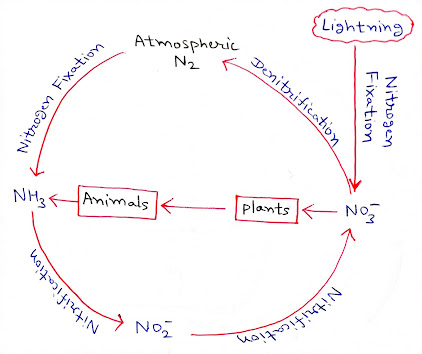
Nitrogen cycle (नाइट्रोजन चक्र):-
> Nitrogen is essential for life form owing to its presence in nucleic acids and proteins. Plants absorb nitrogen through microbial transformations.
(न्यूक्लिक अम्ल और प्रोटीन में उपस्थित होने के कारण नाइट्रोजन जीवन के लिए आवश्यक है। पौधे सूक्ष्मजीवी परिवर्तनों के माध्यम से नाइट्रोजन को अवशोषित करते हैं।)
> Stages (चरण):-
i. Nitrogen fixation (नाइट्रोजन स्थिरीकरण):-
- In this step the atmospheric nitrogen is primarily available in the inert form which is then converted to ammonia which can be used.
(इस चरण में वायुमंडलीय नाइट्रोजन मुख्य रूप से निष्क्रिय रूप में उपलब्ध होती है जिसे बाद में अमोनिया में परिवर्तित किया जाता है जिसका उपयोग किया जा सकता है।)
- During this process the inert form of nitrogen gas is deposited into solid from the atmosphere and surface waters with the help of precipitation.
(इस प्रक्रिया के दौरान नाइट्रोजन गैस का अक्रिय रूप वायुमंडल और सतही जल से वर्षा की सहायता से ठोस में जमा हो जाता है।)
- The nitrogen then undergoes a number of processes to combine with the hydrogen to form ammonia.
(फिर नाइट्रोजन को हाइड्रोजन के साथ मिलकर अमोनिया बनाने के लिए कई प्रक्रियाओं से गुजरना पड़ता है।)
- This whole process of nitrogen fixation is done by symbiotic bacteria.
(नाइट्रोजन स्थिरीकरण की यह पूरी प्रक्रिया सहजीवी जीवाणुओं द्वारा की जाती है।)
- The fixation can occur through atmospheric fixation.
(स्थिरीकरण वायुमंडलीय स्थिरीकरण के माध्यम से हो सकता है।)
ii. Nitrogen assimilation (नाइट्रोजन स्वांगीकरण):- The primary producers tend to consume the nitrogen compounds with the help of roots and they are present in forms such as ammonia, nitrite ammonium ions or nitrate ions. They are used in the formation of proteins.
(प्राथमिक उत्पादक जड़ों की सहायता से नाइट्रोजन यौगिकों का उपभोग करते हैं और वे अमोनिया, नाइट्राइट अमोनियम आयन या नाइट्रेट आयन जैसे रूपों में मौजूद होते हैं। इनका उपयोग प्रोटीन के निर्माण में किया जाता है।)
iii. Ammonification (अमोनीकरण):- When plants or animals die the nitrogen that is present in the organic matter tends to be released back into the soil. The decomposers then take action on the nitrogen present in the soil hence producing ammonia by decomposition.
(जब पौधे या जन्तु मर जाते हैं तो कार्बनिक पदार्थों में उपस्थित नाइट्रोजन वापस मृदा में छोड़ दी जाती है। फिर अपघटक मृदा में उपस्थित नाइट्रोजन पर क्रिया करते हैं जिससे अपघटन द्वारा अमोनिया का उत्पादन होता है।)
iv. Nitrification (नाइट्रीकरण):- In this process the ammonia will be converted into nitrite which is framed by the oxidation of ammonia done by bacteria of Nitrosomonas species. Nitrites are then converted to nitrates which is an important conversion as the ammonia gas produced is very harmful for plants.
(इस प्रक्रिया में अमोनिया को नाइट्राइट में परिवर्तित किया जाता है जो नाइट्रोसोमोनास जाति के जीवाणुओं द्वारा किए गए अमोनिया के ऑक्सीकरण द्वारा तैयार किया जाता है। फिर नाइट्राइट को नाइट्रेट में बदल दिया जाता है जो एक महत्वपूर्ण रूपांतरण है क्योंकि उत्पादित अमोनिया गैस पौधों के लिए बहुत हानिकारक होती है।)
v. Denitrification (विनाइट्रीकरण):- In this step the nitrogen compounds tend to go back to the atmosphere by getting converted to nitrogen from nitrate. This conversion is done by Clostridium and Pseudomonas bacteria.
(इस चरण में नाइट्रोजन यौगिक नाइट्रेट से नाइट्रोजन में परिवर्तित होकर वायुमंडल में वापस चले जाते हैं। यह रूपांतरण क्लोस्ट्रीडियम और स्यूडोमोनास जीवाणुओं द्वारा किया जाता है।)

Ans.
Natural Vegetation of India:- India is bestowed with a wide range of flora and fauna. Due to diverse geographical and climatic conditions, an extensive range of natural vegetation grows in India.
Types of Natural Vegetation in India:-
1. Tropical Evergreen Rain Forests
2. Deciduous or Monsoon Type of Forests
3. Dry Deciduous Forests
4. Mountain Forests
5. Tidal or Mangrove Forests
6. Semi-Desert and Desert Vegetations
1. Tropical Evergreen Rain forests:- The Tropical Evergreen rain forests are found in the areas where precipitation is more than 200 cm. They are largely found in the Northeastern regions of Arunachal Pradesh, Meghalaya, Assam, Nagaland, the Western Ghats, the Tarai areas of the Himalayas, and the Andaman groups of Islands. They are also found in the hills of Khasi and Jaintia. The trees in this area have intense growth. The major trees found in this area are Sandal Wood, Rosewood, Garjan, Mahogany, and bamboo. It has copious vegetation of all kinds – trees, shrubs, and creepers giving it a multilayered structure. The elephants, monkey, lemur are the common animals found in these areas.
2. Deciduous or Monsoon type of forests:- The Deciduous forests are found on the lower slope of the Himalayas, West Bengal, Chhattisgarh, Bihar, Orissa, Karnataka, Maharashtra Jharkhand, and the adjoining areas. The precipitation in this area is between 100 cm and 200 cm. Teak is the dominant species seen in the area. Along with that Deodar, Blue Gum, Pal Ash, Sal, Sandalwood, Ebony, Arjun, Khair, and Bamboo are also seen. The trees in this forest shed their leaves during dry winter and dry summer. Based on the availability of water, these forests are again divided into moist and dry deciduous.
3. Dry deciduous forests:- These forests grow in areas where the precipitation is between 50 cm and 100 cm. These are mainly seen in the areas of the Central Deccan plateau, Punjab, Haryana, parts of Uttar Pradesh, Madhya Pradesh, and South-east of Rajasthan.
4. Mountain Forests/Montane Forests:- Montane forests are those found in mountains. Mountain forests differ significantly along the slopes of the mountain. On the foothills of the Himalayas until a height of 1500 meters, evergreen trees like Sal, teak, and bamboo grow copiously. On the higher slope, temperate conifer trees like pine, fir, and oak grow. At the higher elevation of the Himalayas, rhododendrons and junipers are found. Further, then these vegetation zones, alpine grasslands appear up to the snowfield.
5. Tidal or Mangrove forests:- The tidal or mangrove forests grow by the side of the coast and on the edges of the deltas e.g., the deltas of the Cauvery, Krishna, Mahanadi, Godavari, and Ganga. In West Bengal, these forests are known as ‘Sundarbans’. The ‘Sundari’ is the most major tree in these forests. The important trees of the tidal forests are Hogla, Garan, Pasur, etc. This forest is an important factor in the timber industry as they provide timber and firewood. Palm and coconut trees beautify the coastal strip.
6. Semi-deserts and Deserts vegetations:- This area receives rainfall of less than 50 cm. Thorny bushes, acacia, and Babul are found in this vegetation region. The Indian wild date is generally found here. They have long roots and thick flesh. The plants found in this region store water in their stem to endure during the drought. These vegetation are found in parts of Gujarat’s, Punjab, and Rajasthan.


.png)
.png)


.bmp)


.png)


